
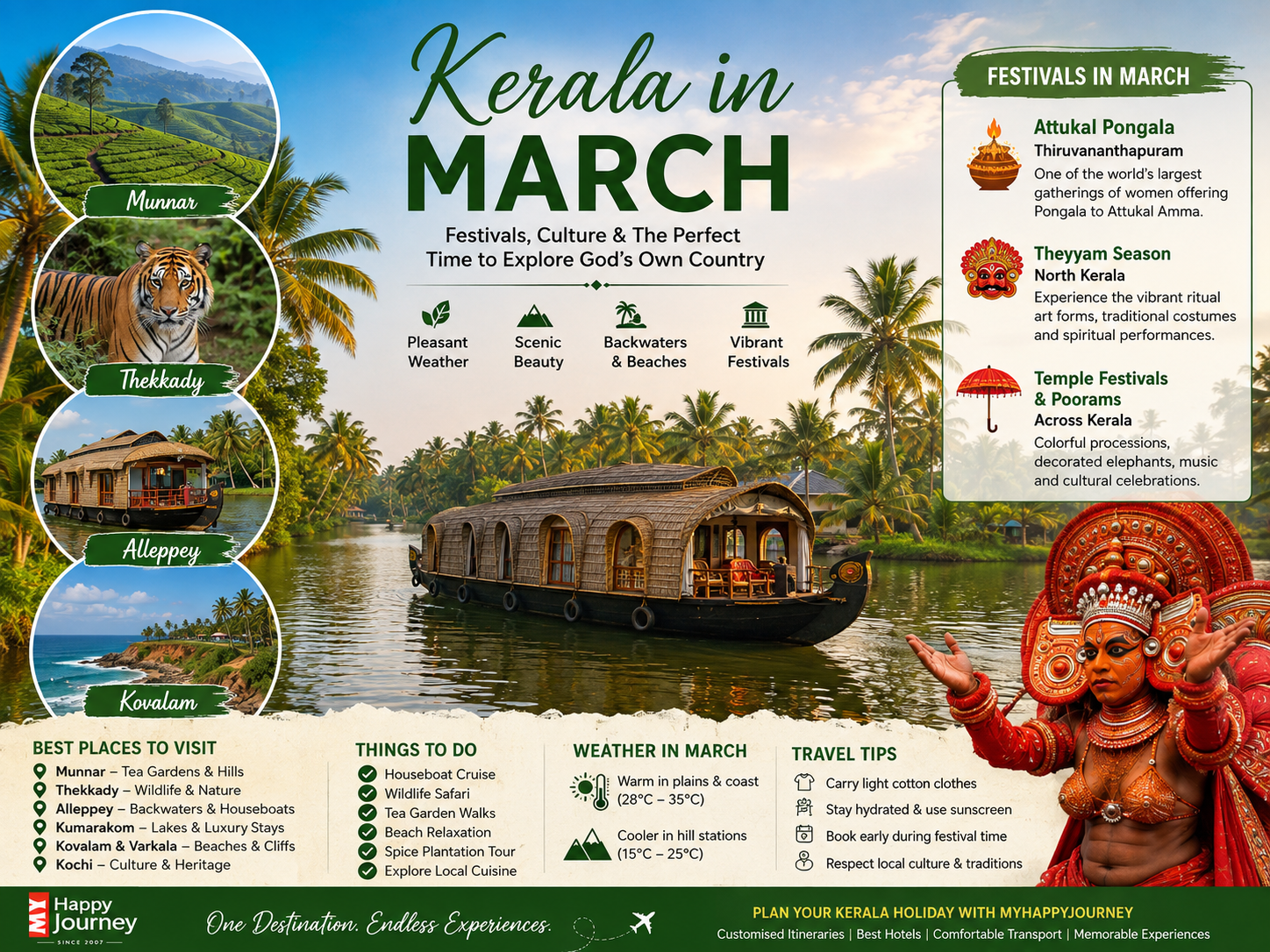
Kerala in March: Festivals, Weather, Places to Visit, Things to Do & Complete Travel Guide
Planning a Kerala trip in March? March is one of the most interesting months to explore Kerala. The weather is generally warm in the lowlands and coastal areas, while destinations such as Munnar and Thekkady offer a cooler escape. It is also a culturally vibrant period, with traditional festivals, temple celebrations and the final phase of the Theyyam season taking place in different parts of the state.
From the misty hills of Munnar and wildlife of Thekkady to the backwaters of Alleppey and beaches of Kovalam, Kerala offers a combination of nature, culture, food and relaxation that works particularly well for families, couples and first-time visitors.
If you are interested in experiencing Kerala beyond sightseeing, March can be a particularly rewarding time because several traditional celebrations take place during this period.
Why Visit Kerala in March?
March marks the transition from the relatively pleasant winter period toward Kerala’s hotter summer months. It is therefore a good time to combine hill stations, wildlife, backwaters and beaches in one holiday.
1. Pleasant weather in the hill stations
Munnar, Thekkady and other high-range destinations are considerably cooler than Kerala’s coastal areas. Munnar is especially attractive for travellers looking for tea plantations, viewpoints, waterfalls and pleasant evenings.
2. Excellent time for a Kerala sightseeing holiday
March is suitable for popular Kerala itineraries covering:
- Kochi
- Munnar
- Thekkady
- Alleppey
- Kumarakom
- Kovalam
- Varkala
- Kanyakumari
3. Experience Kerala’s traditional festivals
March can coincide with important cultural and temple festivals. Attukal Pongala falls around February/March, while the Theyyam season generally extends from December into March. Several Pooram and other temple celebrations also take place around March and April.
4. Great combination of mountains, backwaters and beaches
One of Kerala’s biggest advantages is that travellers can experience very different landscapes within one trip. Kerala Tourism highlights the state’s combination of beaches, backwaters, midlands and Western Ghats destinations.
Kerala Weather in March
March is generally warm in Kerala, particularly in coastal and lowland areas.
During the daytime, temperatures can feel hot, especially in Kochi, Alleppey, Kovalam and Thiruvananthapuram. Hill stations such as Munnar and Thekkady are comparatively comfortable.
What to expect
Munnar: Cooler mornings and evenings, comfortable for sightseeing.
Thekkady: Pleasant compared with the coastal plains, although afternoons can be warm.
Kochi: Warm and humid, particularly during the afternoon.
Alleppey: Warm and humid, but ideal for a relaxed backwater experience.
Kovalam: Hot and sunny, making early morning and evening beach time more comfortable.
What should you pack?
For a March Kerala holiday, carry:
- Lightweight cotton clothes
- Comfortable walking shoes
- Sunglasses
- Sunscreen
- Hat or cap
- Reusable water bottle
- Light jacket or shawl for Munnar evenings
- Umbrella or light rain protection
- Comfortable traditional clothing if visiting temples
Kerala Tourism also recommends comfortable, loose cotton clothing for most seasons, with warmer layers useful in high-range destinations such as Munnar and Thekkady.
Festivals in Kerala During March
March is particularly interesting for travellers who want to experience Kerala’s cultural side.
1. Attukal Pongala – Thiruvananthapuram
Location: Attukal Bhagavathy Temple, Thiruvananthapuram
Attukal Pongala is one of Kerala’s most distinctive religious and cultural celebrations. It is traditionally celebrated during the Malayalam months of Makaram-Kumbham, which generally correspond to February–March.
The festival is renowned for the enormous gathering of women who prepare Pongala, a sweet offering traditionally made using ingredients such as rice, jaggery and coconut.
The streets surrounding the temple become part of the ritual space, creating an extraordinary atmosphere of devotion and community participation. Kerala Tourism describes Attukal Pongala as one of the world’s largest gatherings of women for a festival.
Why is Attukal Pongala important?
The festival is associated with devotion to Attukal Bhagavathy, popularly known as Attukalamma. The preparation and offering of Pongala is considered an act of devotion and prayer.
For visitors, it provides an opportunity to understand an important part of Kerala’s living cultural heritage.
Travel tip
If you are planning to visit Thiruvananthapuram specifically for Attukal Pongala, plan accommodation and transportation well in advance because the festival attracts enormous crowds. Kerala Tourism also advises travellers to book accommodation early for major festivals.
2. Theyyam Season – North Kerala
If you want to experience something truly different, March can be a good time to explore Theyyam in North Kerala.
Theyyam is a traditional ritual performance combining dance, music, elaborate costumes, makeup and religious traditions. Performers appear in striking costumes and elaborate headgear and represent various deities and mythical characters.
The Theyyam season generally runs from December to March, making March one of the final opportunities in the annual season to experience these performances.
Where can you experience Theyyam?
Theyyam is strongly associated with northern Kerala, particularly areas around:
- Kannur
- Kasaragod
- Kozhikode
- North Malabar
The experience is very different from a conventional tourist attraction because Theyyam is a living ritual tradition connected with local communities and sacred spaces.
Important etiquette
Visitors should remember that Theyyam is a religious and cultural ritual rather than a staged tourist show.
When attending:
- Dress respectfully.
- Follow instructions from temple authorities.
- Ask before taking photographs.
- Avoid disturbing performers or devotees.
- Maintain appropriate behaviour during rituals.
3. Pooram Festivals Around March and April
Kerala’s Pooram festivals are among the state’s most visually impressive cultural celebrations.
Poorams generally involve temple processions, traditional percussion, decorated elephants, colourful ceremonial umbrellas and other rituals. Kerala Tourism describes Pooram festivals as an important part of Kerala’s cultural tradition.
Several Pooram celebrations occur around March and April.
Important note about Thrissur Pooram
Many travellers search for “Thrissur Pooram in March.” However, Thrissur Pooram is generally celebrated in April or May, depending on the Malayalam calendar. Kerala Tourism currently lists it in the Malayalam month of Medam, corresponding to April–May.
Therefore, if your main objective is to experience Thrissur Pooram, check the official festival calendar for the specific year before booking your trip.
Best Places to Visit in Kerala in March
Munnar
Munnar is one of the best destinations for a March Kerala holiday.
Highlights include:
- Tea plantations
- Tea museums
- Mattupetty Dam
- Echo Point
- Kundala Lake
- Eravikulam National Park
- Scenic mountain viewpoints
- Waterfalls
- Tea estate walks
Munnar is particularly suitable for couples, families and travellers looking for a cooler mountain destination.
Thekkady
Thekkady is ideal for travellers who want nature and wildlife.
Popular experiences include:
- Periyar Wildlife Sanctuary
- Boat safari
- Bamboo rafting
- Spice plantation visits
- Nature walks
- Tribal village experiences
- Elephant-related experiences
- Plantation tours
Thekkady is also a good stop between Munnar and Kerala’s southern destinations.
Alleppey
Alleppey, also known as Alappuzha, is famous for its backwaters and houseboats.
A typical houseboat experience includes:
- Cruising through backwaters
- Village views
- Coconut plantations
- Traditional Kerala food
- Sunset views
- Overnight stay on the houseboat
A Kerala trip without experiencing the backwaters can feel incomplete for first-time visitors.
Kerala Tourism also identifies a houseboat ride through the backwaters as one of the experiences visitors should not miss.
Kumarakom
Kumarakom is another excellent backwater destination.
Compared with the more active Alleppey houseboat experience, Kumarakom is particularly attractive to travellers looking for:
- Resort stays
- Backwater cruises
- Bird watching
- Relaxation
- Couples’ holidays
- Premium Kerala experiences
Kovalam
Kovalam is one of Kerala’s best-known beach destinations.
In March, the weather can be warm, so beach activities are generally more comfortable during the morning and evening.
Popular experiences include:
- Lighthouse Beach
- Hawa Beach
- Samudra Beach
- Sunset views
- Ayurveda and wellness experiences
- Seafood
- Beachside relaxation
Varkala
Varkala is another excellent option for a March holiday.
The famous Varkala Cliff offers panoramic views of the Arabian Sea and is surrounded by restaurants, shops and accommodation.
Varkala works particularly well for:
- Couples
- Backpackers
- Wellness travellers
- Beach holidays
- Short Kerala breaks
Kochi
Kochi is often the starting point for a Kerala holiday.
Spend time exploring:
- Fort Kochi
- Chinese fishing nets
- Mattancherry
- Jew Town
- St. Francis Church
- Mattancherry Palace
- Local cafés
- Kerala cuisine
Kochi is particularly useful as the arrival or departure point for a Kerala itinerary.
Sample Kerala Itinerary for March
6 Nights / 7 Days
Day 1 – Kochi
Arrive in Kochi.
Visit:
- Fort Kochi
- Chinese fishing nets
- Mattancherry
- Jew Town
Overnight in Kochi.
Day 2 – Kochi to Munnar
Travel to Munnar.
Enjoy the scenic drive through the Western Ghats.
Overnight in Munnar.
Day 3 – Munnar Sightseeing
Explore:
- Tea plantations
- Mattupetty Dam
- Echo Point
- Kundala Lake
- Tea Museum
Overnight in Munnar.
Day 4 – Munnar to Thekkady
Proceed to Thekkady.
Visit a spice plantation and explore the local area.
Overnight in Thekkady.
Day 5 – Thekkady to Alleppey
Proceed to Alleppey.
Check in to a traditional Kerala houseboat and enjoy a backwater cruise.
Overnight on the houseboat.
Day 6 – Alleppey to Kovalam
Proceed to Kovalam.
Relax at the beach and enjoy the evening.
Overnight in Kovalam.
Day 7 – Kovalam / Thiruvananthapuram Departure
Depending on your departure time, visit:
- Kovalam
- Thiruvananthapuram
- Padmanabhaswamy Temple area
Proceed to the airport or railway station.
Kerala Food to Try in March
A Kerala holiday should include local cuisine.
Try:
Kerala Sadya
A traditional vegetarian feast served on a banana leaf.
Appam and Stew
Soft rice-based appam served with a coconut-based stew.
Kerala Parotta and Curry
A popular combination found across the state.
Puttu and Kadala Curry
A traditional Kerala breakfast.
Fish Curry
Kerala-style fish curry is particularly popular in coastal areas.
Banana Chips
A classic Kerala snack.
Payasam
A traditional sweet dish often served during celebrations and special occasions.
Is March a Good Time for a Kerala Family Holiday?
Yes.
March can be a good option for families because you can combine:
- Hill stations
- Wildlife
- Backwaters
- Beaches
- Cultural experiences
Families with children should plan outdoor sightseeing around the hotter parts of the day and keep sufficient water and sun protection available.
Is March Good for a Kerala Honeymoon?
Yes.
A March Kerala honeymoon can combine:
Munnar + Thekkady + Alleppey + Kovalam
This gives couples:
- Mountain views
- Tea plantations
- Romantic resorts
- Wildlife experiences
- Private houseboat experiences
- Backwaters
- Beaches
For a more relaxed honeymoon, you can also consider:
Munnar + Kumarakom + Kovalam
Kerala in March: Advantages and Disadvantages
Advantages
- Good time to explore hill stations
- Excellent combination of mountains, backwaters and beaches
- Cultural festivals may be taking place
- Theyyam season continues in North Kerala
- Good conditions for sightseeing with proper planning
- Suitable for family and couple holidays
Things to Keep in Mind
- Coastal areas can become hot during afternoons.
- Popular hotels can fill up during festival periods.
- Festival dates vary according to the Malayalam calendar.
- Major festivals can cause traffic and crowding.
- Festival-specific travel should be planned well in advance.
Kerala Tourism specifically notes that festival dates are based on the Malayalam calendar and local traditions and should be confirmed with local authorities because dates can change.
Frequently Asked Questions About Kerala in March
1. Is March a good month to visit Kerala?
Yes. March is a good month for a Kerala holiday, particularly if you want to combine Munnar, Thekkady, Alleppey and Kovalam.
2. Is Kerala very hot in March?
Coastal and lowland areas can be hot and humid, especially during the afternoon. Hill stations such as Munnar and Thekkady are generally more comfortable.
3. Can I visit Munnar in March?
Yes. Munnar is one of the better destinations to include in a March Kerala itinerary.
4. Is March good for a Munnar honeymoon?
Yes. Couples can enjoy the tea plantations, scenic viewpoints, resorts and cooler hill-station environment.
5. Can I stay on a Kerala houseboat in March?
Yes. March is suitable for an Alleppey or Kumarakom houseboat experience. For an overnight houseboat, choose a reputable operator and check the facilities before booking.
6. Is March good for Alleppey?
Yes. Alleppey is an excellent destination for experiencing Kerala’s backwaters.
7. Is March good for Kovalam?
Yes. Kovalam is suitable for a beach holiday in March, although afternoons can be hot.
8. Can I see Theyyam in March?
Potentially, yes. The Theyyam season generally extends from December to March, but individual performances have specific dates and locations. Check the local schedule before travelling.
9. What is Attukal Pongala?
Attukal Pongala is a major festival held at Attukal Bhagavathy Temple in Thiruvananthapuram. Women gather to prepare Pongala as an offering to the deity. The festival usually falls during February–March.
10. Is Attukal Pongala held every year?
Yes, it is an annual festival. However, the exact date should be checked for the year of travel because Kerala’s festival dates follow the Malayalam calendar and local traditions.
11. Is Thrissur Pooram held in March?
Usually no. Thrissur Pooram is generally held in April or May. Travellers should check the official date for the particular year.
12. Is March good for Thrissur?
Yes, Thrissur is worth visiting in March for its cultural heritage and temple traditions, but if your primary purpose is Thrissur Pooram, plan according to the festival’s actual annual date.
13. What clothes should I wear in Kerala in March?
Light cotton clothing is ideal for most destinations. Carry a light jacket for Munnar and Thekkady, especially for mornings and evenings.
14. Should I carry sunscreen for Kerala in March?
Yes. Sunscreen, sunglasses, a hat and adequate drinking water are recommended, particularly for daytime sightseeing.
15. How many days are enough for Kerala?
For a first trip, 5 to 7 days is a good starting point. A 6-night/7-day itinerary can comfortably cover Munnar, Thekkady, Alleppey and Kovalam.
For a more relaxed holiday, consider 7–9 nights.
16. Which is better in March: Munnar or Alleppey?
They offer completely different experiences.
Munnar: mountains, tea plantations and cooler weather.
Alleppey: backwaters, villages and houseboats.
For a first Kerala trip, including both is ideal.
17. Is March good for a Kerala family trip from Bangalore?
Yes. Kerala is easily accessible from Bangalore by road, train and air, and a 6–7 day itinerary can cover the major destinations without making the trip excessively rushed.
18. Is March good for a Kerala road trip?
Yes, provided the itinerary is planned sensibly. Avoid packing too many destinations into one day because Kerala’s winding roads and mountain routes can make travel times longer than expected.
19. Which Kerala itinerary is best for March?
A classic itinerary is:
Kochi → Munnar → Thekkady → Alleppey → Kovalam
For 6 nights:
2 Nights Munnar + 1 Night Thekkady + 1 Night Alleppey Houseboat + 2 Nights Kovalam
For 7 nights:
1 Night Kochi + 2 Nights Munnar + 1 Night Thekkady + 1 Night Alleppey Houseboat + 2 Nights Kovalam
20. Should I book Kerala hotels early for March?
If your travel dates coincide with a major festival or holiday period, early booking is recommended. Festival periods can create higher demand for accommodation and transportation.
Final Verdict: Should You Visit Kerala in March?
Yes — March can be an excellent month for a Kerala holiday.
It offers a wonderful combination of:
Munnar’s mountains + Thekkady’s wildlife + Alleppey’s backwaters + Kovalam’s beaches + Kerala’s traditional culture.
For travellers interested in culture, March can be particularly rewarding because of festivals such as Attukal Pongala, the continuing Theyyam season, and various regional temple celebrations. However, festival dates should always be checked for the exact year before finalising your itinerary.
If your priority is Thrissur Pooram, plan specifically for its April–May date rather than assuming it will fall in March.
Plan Your Kerala Holiday with MyHappyJourney
Whether you are looking for a Kerala family holiday, honeymoon package, Kerala houseboat experience, Munnar tour, Kerala sightseeing package or a customised Kerala itinerary, your trip can be designed around your preferred destinations, hotel category, transport and number of nights.
MyHappyJourney — Discover Kerala with a personalised itinerary designed around your travel style.