
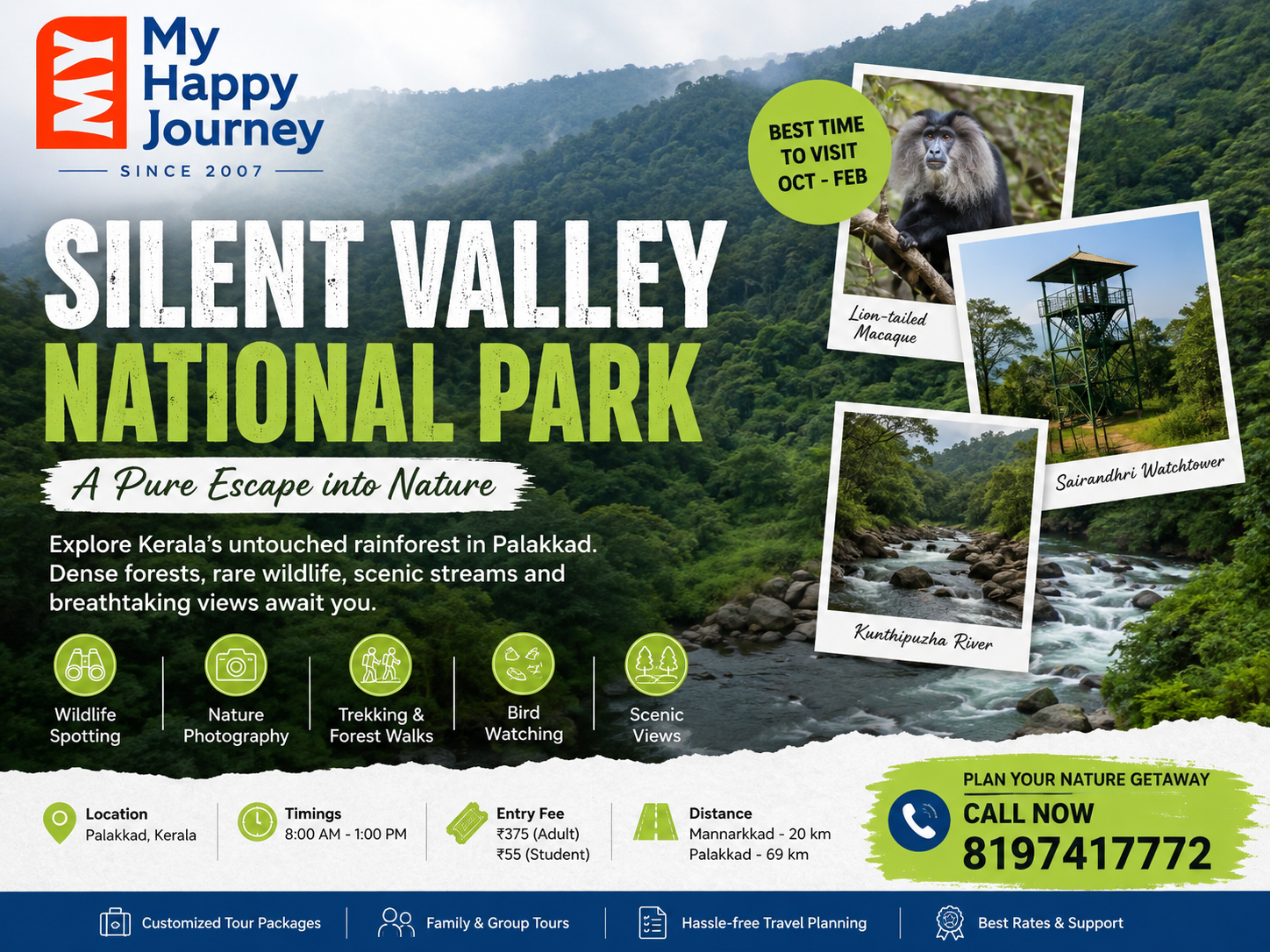
Travel Guide: Things to Do, Timings, Entry Fee & Best Time to Visit
If you are looking for a place in Kerala where nature still feels genuinely wild and untouched, Silent Valley National Park deserves a place on your travel list. Located in the Western Ghats of Palakkad district, this protected rainforest is known for its incredible biodiversity, dense evergreen forests, mountain landscapes and the rare lion-tailed macaque.
Unlike many popular tourist destinations in Kerala, Silent Valley is not about crowded viewpoints, shopping streets or a long list of commercial attractions. The experience here is much quieter and more immersive. You travel into the forest, surrounded by greenery, listen to birds and flowing water, and get a glimpse of one of Kerala’s most important natural ecosystems.
This Silent Valley National Park travel guide covers everything you need to know before visiting, including the location, sightseeing options, timings, entry fee, distance, how to reach, best time to visit and useful travel tips.
Silent Valley National Park at a Glance
| Information | Details |
|---|---|
| Location | Palakkad district, Kerala |
| Nearest town | Mannarkkad |
| Main entry point | Mukkali |
| Area | Approximately 237.52 sq. km |
| Landscape | Tropical evergreen rainforest and Western Ghats |
| Famous for | Biodiversity, lion-tailed macaque, rainforest ecosystem |
| Nearest railway station | Palakkad |
| Nearest major airport | Coimbatore International Airport |
| Ideal for | Nature lovers, wildlife enthusiasts, photographers and adventure seekers |
| Visitor entry | Regulated by Kerala Forest Department |
Silent Valley is part of the Nilgiri Biosphere Reserve and represents one of the important remaining stretches of tropical evergreen forest in the Western Ghats. The Kerala Forest Department describes it as a protected area with exceptional biodiversity and ecological importance.
What Makes Silent Valley National Park Special?
The first thing you notice about Silent Valley is how different it feels from conventional tourist destinations.
There are no rows of commercial attractions inside the forest. Instead, the attraction is the forest itself.
The park covers around 237.52 square kilometres and contains tropical evergreen rainforest, streams, valleys and mountainous terrain. It is home to a wide range of plants, birds, mammals and other wildlife.
One of its best-known residents is the lion-tailed macaque, an endangered primate associated with the Western Ghats. Other wildlife found in the region includes Nilgiri langur and Malabar giant squirrel.
The park is also closely associated with the famous Save Silent Valley movement, an environmental campaign that helped prevent a proposed hydroelectric project and contributed to the protection of the region.
That history gives Silent Valley an importance that goes beyond tourism. Visiting the park is also an opportunity to understand why protecting the Western Ghats matters.
Silent Valley National Park Location
The Silent Valley National Park location is in the northeastern part of Palakkad district in Kerala.
The main visitor access point is at Mukkali, which is around 20 km from Mannarkkad. From Mukkali, access to the forest is controlled by the Forest Department.
The official Kerala Tourism information places the nearest railway station at Palakkad and the nearest major airport at Coimbatore International Airport.
Location in simple terms
Palakkad → Mannarkkad → Mukkali → Silent Valley
If you are travelling from Palakkad or other parts of Kerala, Mannarkkad is an important point to keep in mind when planning your route.
Silent Valley National Park Distance
The Silent Valley National Park distance depends on your starting point.
Some useful reference distances are:
- Mannarkkad to Mukkali: approximately 20 km
- Palakkad to Silent Valley region: roughly 60–70 km depending on the access point and route
- Palakkad railway station: approximately 69 km according to Kerala Tourism
- Coimbatore International Airport: approximately 91 km according to Kerala Tourism
Travel time can vary considerably depending on road conditions, traffic and the specific visitor programme you have booked.
For this reason, it is better to plan Silent Valley as a dedicated sightseeing experience rather than trying to squeeze it into a very tight itinerary.
Silent Valley National Park Sightseeing
Silent Valley National Park sightseeing is primarily about experiencing the forest rather than visiting multiple man-made attractions.
Some of the highlights include:
1. Sairandhri
Sairandhri is one of the important visitor areas associated with Silent Valley.
It provides access towards the core forest region and offers visitors the opportunity to experience the rainforest landscape.
The area is particularly interesting for people who enjoy wildlife observation and nature photography.
2. Sairandhri Watchtower
The watchtower is one of the memorable attractions associated with Silent Valley sightseeing.
From the elevated viewpoint, visitors can enjoy views across the forested landscape and surrounding hills. Kerala Tourism highlights the watchtower as a major attraction at Sairandhri.
Don’t expect a conventional hill-station viewpoint. The charm here comes from seeing a vast stretch of forest rather than buildings and roads.
3. Kunthipuzha River
The Kunthipuzha River is an important natural feature of Silent Valley.
The river flows through the park and contributes to the forest ecosystem. From elevated viewpoints, the river can appear as a narrow silver line cutting through the greenery.
It is one of the beautiful natural elements to look out for during your visit.
4. Tropical Evergreen Forest
For many visitors, the forest itself is the main attraction.
The dense vegetation creates a completely different atmosphere from the usual Kerala sightseeing circuit.
Look carefully and you may notice birds, insects, butterflies, unusual plants and signs of wildlife that you might otherwise miss.
The key is patience.
Silent Valley is not a place where wildlife is guaranteed to appear on demand.
5. Wildlife Watching
Silent Valley is home to rich biodiversity, including the endangered lion-tailed macaque.
Depending on the season, route and luck, visitors may encounter different species of birds and animals.
However, wildlife sightings should never be treated as guaranteed.
The Kerala Forest Department itself advises visitors not to expect to see animals all the time and stresses the importance of patience, silence and responsible behaviour inside forests.
Things to Do in Silent Valley National Park
If you are planning Silent Valley National Park tourism, here are some of the best experiences to consider.
Wildlife spotting
Keep your eyes and ears open while travelling through the forest. Even when you don’t see a large animal, bird calls, butterflies, insects and smaller creatures can make the experience memorable.
Nature photography
The dense rainforest, mountain scenery, streams and wildlife create excellent opportunities for nature photography.
Avoid disturbing animals or plants simply to get a photograph.
Birdwatching
Silent Valley’s forest ecosystem supports a wide variety of birdlife. Birdwatchers should carry binoculars and allow enough time for observation.
Trekking
Trekking and nature-oriented activities are available under regulated Forest Department programmes. Current charges and availability can vary by activity, so check the official booking system before travelling.
Forest experience
Perhaps the best thing to do is simply slow down.
Listen to the forest, observe the vegetation and enjoy the quietness. Silent Valley rewards visitors who are willing to experience nature rather than rush from one attraction to another.
Silent Valley National Park Timings
The Silent Valley National Park timings are important because entry into the protected forest is regulated.
Kerala Tourism states that entry to the national park is from 8:00 AM to 1:00 PM.
Silent Valley National Park Opening Time
Opening time: 8:00 AM
The older official park information also states that visitors are routinely admitted between 8:00 AM and 1:00 PM, with permission obtained through the appropriate Forest Department offices.
Because forest access can be affected by weather, safety conditions and operational changes, it is advisable to confirm the latest timings and availability before travelling. The Kerala Forest Ecotourism portal specifically notes that entry and exit timings can change because of weather and emergencies.
Silent Valley National Park Entry Fee
The Silent Valley National Park entry fee is not necessarily a simple walk-in ticket like an ordinary tourist attraction. Charges can depend on the visitor category and the activity or package selected.
The Kerala Forest Department’s published statistics list the following charges for Silent Valley:
- Indian adult by bus: ₹375
- Indian student: ₹55
- Light motor vehicle parking: ₹15
- Heavy vehicle parking: ₹20
- Trekking: ₹2,000
- Panthamthodu Camp: ₹2,500
These published charges should be treated as a reference rather than a guarantee of the current payable amount.
Silent Valley National Park Ticket Price
The Silent Valley National Park ticket price can change depending on the package, activity, visitor category and Forest Department rules.
The safest approach is to check the official Kerala Forest Ecotourism booking portal before your trip. Online reservations can open up to 45 days before the visit, and the department states that bookings should be made through its authorised platform.
Best Time to Visit Silent Valley National Park
The Silent Valley National Park best time to visit depends on what you want from the experience.
For comfortable sightseeing and better opportunities for outdoor activities, the months outside the heaviest monsoon periods are generally more convenient.
October to February
This is a popular period for visiting Kerala’s forest destinations.
The weather is generally more comfortable for travelling and spending time outdoors.
This period is particularly suitable for:
- Nature sightseeing
- Photography
- Wildlife observation
- Forest experiences
- Family trips
March to May
The weather can become warmer, especially outside the forested areas.
However, the forest environment can still be appealing to nature lovers.
If travelling during this period, start early and carry sufficient drinking water.
June to September
The southwest monsoon brings substantial rainfall to Kerala.
The rainforest becomes intensely green and atmospheric, but heavy rain can affect road travel, visibility and forest activities.
Forest access can also be subject to weather and safety decisions.
So, when should you visit?
For most travelers, October to February is a comfortable choice.
However, if your priority is experiencing the rainforest during its lushest period and you are comfortable with wet-weather travel, the monsoon season can offer a completely different atmosphere.
Always confirm operational status before travelling because forest-entry conditions can change with weather.
How to Reach Silent Valley National Park
By Road
Road travel is the most practical way to reach the visitor access area.
From Palakkad, travel towards Mannarkkad and then continue towards Mukkali.
Mukkali is the main access point for the park.
From there, forest access is regulated by the Forest Department and visitors may need to use authorised vehicles or programmes for entering deeper forest areas.
Kerala Tourism notes that buses are available between Mannarkkad and Mukkali, while forest access beyond Mukkali is handled through Forest Department arrangements.
By Train
The nearest major railway station is Palakkad Railway Station, approximately 69 km away according to Kerala Tourism.
From Palakkad, you can continue by road towards Mannarkkad and Mukkali.
By Air
The nearest major airport listed by Kerala Tourism is Coimbatore International Airport, around 91 km away.
This makes Silent Valley a possible addition to a Kerala itinerary that begins in or around Coimbatore.
How Much Time Do You Need for Silent Valley?
Silent Valley is best visited without rushing.
One day
A one-day visit can work well if you are staying around Palakkad or Mannarkkad and want to experience the park without staying overnight.
Two days
Two days provide more flexibility and allow you to combine Silent Valley with nearby attractions or spend more time around the Mannarkkad region.
Part of a Kerala itinerary
If you are planning a larger Kerala holiday, Silent Valley can be included as a nature-focused stop between destinations in northern or central Kerala.
However, check travel distances carefully before combining it with multiple attractions on the same day.
Suggested Silent Valley National Park One-Day Itinerary
Morning
Start early from your hotel and travel towards Mannarkkad and Mukkali.
Complete the required entry formalities and begin your forest visit.
Late Morning
Explore the forest route towards Sairandhri and enjoy the surrounding rainforest.
Keep your camera ready, but remember that wildlife sightings are unpredictable.
Afternoon
Spend time at the viewpoint/watchtower and take in the forest landscape.
Depending on your selected programme and current operating conditions, your itinerary may include additional nature-oriented activities.
Evening
Return towards Mannarkkad or your onward destination.
If you are planning to drive a long distance after the visit, avoid creating an unnecessarily tight schedule.
Silent Valley for Different Travelers
For Families
Silent Valley can be a rewarding family experience, especially for children interested in animals, forests and nature.
Parents should prepare children beforehand about forest rules and the importance of staying quiet.
For Couples
If you prefer peaceful nature experiences over crowded tourist attractions, Silent Valley can make an interesting addition to a Kerala trip.
For Nature Lovers
This is where Silent Valley really stands out.
The rainforest ecosystem, biodiversity and protected landscape make it one of the more meaningful nature experiences in Kerala.
For Photographers
Landscape and wildlife photographers can find plenty to photograph, particularly if they are patient.
Remember to follow Forest Department rules regarding photography and wildlife.
For Senior Travelers
The suitability depends on the selected activity and walking requirements. A comfortable vehicle-based forest experience may be preferable to demanding trekking programmes.
Travel Tips for Silent Valley National Park
Keep these points in mind before visiting:
- Check the latest entry rules before travelling.
- Confirm the current ticket price and activity charges.
- Book authorised ecotourism activities in advance where required.
- Start your journey early.
- Carry drinking water.
- Wear comfortable clothing and footwear.
- Avoid bright or flashy clothing while entering forest areas.
- Do not feed animals.
- Do not litter.
- Do not play loud music.
- Follow the instructions of Forest Department staff and guides.
- Do not wander away from permitted routes.
- Keep a safe distance from wildlife.
- Avoid smoking and open fires.
- Carry binoculars if you enjoy birdwatching.
- Do not assume that wildlife sightings are guaranteed.
The Kerala Forest Department specifically recommends silence, small groups, drinking water, guides and responsible behaviour inside forest areas.
Is Silent Valley National Park Worth Visiting?
Yes, especially if you enjoy forests, wildlife and quiet destinations.
Silent Valley is not the best choice if you are looking for a packed sightseeing schedule with restaurants, shopping and easily accessible attractions at every stop.
But if your idea of a good holiday is travelling through a beautiful rainforest, watching birds, looking for wildlife and spending time away from crowded tourist areas, Silent Valley is an excellent choice.
Its importance also goes beyond tourism. The park represents a significant conservation success story in Kerala and protects an ecosystem that is valuable to the Western Ghats.
Frequently Asked Questions About Silent Valley National Park
Silent Valley National Park is one of Kerala’s most remarkable rainforest destinations. Located in the Nilgiri Hills of Palakkad district, the park protects a largely undisturbed tropical evergreen ecosystem and is especially known for its biodiversity, endemic species and the famous lion-tailed macaque. The park covers about 237.52 sq km, including its core and buffer areas.
If you are planning a visit, these frequently asked questions cover everything from the best time to visit and entry timings to wildlife, trekking, how to reach Silent Valley and practical travel tips.
1. What is Silent Valley National Park famous for?
Silent Valley National Park is famous for its pristine tropical evergreen rainforest and exceptional biodiversity. It is one of the best-preserved rainforest ecosystems in Kerala and provides habitat for several rare and endemic species.
The park is particularly associated with the lion-tailed macaque, Nilgiri langur and Malabar giant squirrel. More than 200 bird species have also been recorded in the park.
2. Where is Silent Valley National Park located?
Silent Valley National Park is located in Palakkad district, Kerala, in the Nilgiri Hills of the Western Ghats.
The main visitor entry point is Mukkali, which is around 20 km from Mannarkkad. From Mukkali, visitors proceed towards the Sairandhri area of the national park.
3. How far is Silent Valley National Park from Palakkad?
Silent Valley is approximately 60 km from Palakkad according to Kerala Forest Department tourism information.
The actual travel time can vary depending on the route, road conditions and traffic.
4. How far is Silent Valley National Park from Mannarkkad?
The main entry point, Mukkali, is approximately 20 km from Mannarkkad. Mannarkkad is therefore one of the most convenient towns from which to approach Silent Valley.
5. When was Silent Valley declared a national park?
Silent Valley was declared a national park in 1984 and formally inaugurated in 1985. The original protected area was about 89.52 sq km. An additional 148 sq km was subsequently added as a buffer zone in 2007.
6. Why is Silent Valley called Silent Valley?
The name refers to the remarkably quiet and undisturbed character of the rainforest. Unlike many tourist destinations, Silent Valley is not developed around large numbers of visitors or commercial attractions.
The official Silent Valley website describes it as one of Kerala’s remaining rainforests and highlights its conservation history.
7. What is the area of Silent Valley National Park?
Silent Valley National Park currently covers approximately 237.52 sq km. The original 89.52 sq km protected area became the core zone, while additional forest was incorporated as buffer area in 2007.
8. What animals can be seen in Silent Valley National Park?
Silent Valley supports a wide range of wildlife. Some of the notable species include:
- Lion-tailed macaque
- Nilgiri langur
- Malabar giant squirrel
- Elephant
- Tiger
- Leopard
- Gaur
- Sambar
- Wild boar
- Various reptiles, amphibians and smaller mammals
The park is particularly important for species associated with the Western Ghats.
9. Can I see lion-tailed macaques at Silent Valley?
The lion-tailed macaque is one of Silent Valley’s most famous inhabitants. The park provides important habitat for this endangered Western Ghats primate.
However, seeing one during a particular visit cannot be guaranteed. These are wild animals living in dense rainforest.
10. Is Silent Valley National Park good for birdwatching?
Yes. Silent Valley is an excellent destination for bird enthusiasts because its rainforest ecosystem supports a diverse bird population.
More than 200 bird species have been recorded within the park, including endemic and migratory species.
If birdwatching is your main reason for visiting, carrying binoculars and allowing plenty of time for quiet observation can make the experience much more rewarding.
11. What birds can I see in Silent Valley?
Birdlife varies depending on the season and location within the park. Visitors may encounter a variety of forest birds, including species associated with the Western Ghats.
Because Silent Valley is a dense rainforest rather than an open bird sanctuary, many birds are easier to hear than see. Patience is an important part of rainforest birdwatching.
12. What is the best time to visit Silent Valley National Park?
For comfortable outdoor activities, the drier months are generally preferable, particularly from around November to April.
However, Silent Valley is a rainforest, so the landscape can remain lush throughout the year. During periods of heavy rain, access, trekking and other activities may be affected.
The Kerala Forest Department also notes that ecotourism activities can be modified or cancelled because of weather, landslides, floods, forest fires and other unforeseen circumstances.
13. What are the timings of Silent Valley National Park?
Current tourism information from Incredible India lists the visitor timing as approximately 8:00 AM to 1:00 PM. Kerala Tourism has also historically published the Mukkali entry window as 8:00 AM to 1:00 PM.
Because forest access is controlled and timings can change, it is important to confirm the schedule before travelling.
14. Can I enter Silent Valley National Park in the afternoon?
You should not assume that afternoon entry is available.
Published visitor information gives the entry window as 8:00 AM to 1:00 PM, so travellers should plan to arrive early rather than reaching Mukkali late in the day.
15. Is there an entry fee for Silent Valley National Park?
Yes, entry and activity charges apply, but fees can change.
An older Kerala Forest Department tourism schedule listed ₹35 for adults, ₹25 for students and ₹220 for foreign visitors, including the watchtower fee.
Because this information is from an older published tariff, visitors should verify the current Silent Valley entry fee and package charges before booking.
16. Can I book Silent Valley National Park tickets online?
Kerala Forest Department now operates a centralised ecotourism booking portal covering its ecotourism centres and packages. The department states that online reservations open up to 45 days before the visit, and reservations must be made through its authorised portal or mobile application.
For Silent Valley specifically, check the currently available package before planning your itinerary.
17. Can I visit Silent Valley without a guide?
Silent Valley is a protected forest, and visitors should follow the authorised access arrangements rather than treating it like an ordinary tourist attraction.
The Kerala Forest Department recommends seeking the assistance of a guide when entering forests and states that travelling alone in forest areas is not welcomed and is prohibited under its ecotourism guidance.
18. Can I go trekking at Silent Valley National Park?
Yes. Trekking and nature experiences are among the activities associated with Silent Valley.
The attraction is less about adventure trekking and more about experiencing the rainforest, its wildlife and its ecological environment responsibly.
19. Is Silent Valley suitable for beginner trekkers?
That depends on the particular route and programme.
Visitors should select an authorised activity appropriate to their fitness level and follow the instructions of forest staff or guides. Silent Valley is a protected rainforest, so visitors should not attempt independent exploration of unfamiliar trails.
20. Can I go on a jeep safari in Silent Valley?
Silent Valley is not best understood as a conventional wildlife safari destination with open-ended safari drives.
Visitor experiences are regulated around authorised access routes and ecotourism activities. Depending on the current programme, vehicles may be used to access permitted areas, but visitors should check the specific package rather than assuming a traditional jeep safari is available.
21. What is Sairandhri in Silent Valley?
Sairandhri is an important visitor point within Silent Valley National Park and is associated with access to the core forest area.
Kerala Tourism describes visitors as being permitted to travel up to the forest station at Sairandhri, which serves as the entry point to the core area.
22. What is Mukkali?
Mukkali is the main entry point and access area for Silent Valley National Park.
It lies on the Mannarkkad–Attappady route and is approximately 20 km from Mannarkkad. The forest department manages access to the national park from this area.
23. How do I reach Silent Valley National Park?
The usual approach is:
Palakkad/Mannarkkad → Mukkali → Silent Valley
Mannarkkad is an important access town, while Mukkali serves as the principal entry point.
Travellers arriving by air can use Coimbatore International Airport or Cochin International Airport, depending on their overall Kerala itinerary.
24. Can I visit Silent Valley from Kochi?
Yes, but it is a relatively long road journey, so it is better incorporated into a multi-day Kerala itinerary rather than treated as a quick sightseeing stop.
A practical route could be:
Kochi → Silent Valley → Palakkad → Munnar
or
Kochi → Silent Valley → Thrissur → Kochi
The best route depends on what other destinations you want to include.
25. Can I visit Silent Valley from Coimbatore?
Yes. Coimbatore is a practical gateway for travellers coming from Tamil Nadu.
A Silent Valley trip can be combined with destinations in Palakkad and the Western Ghats, although visitors should plan around the park’s morning access window.
26. Is Silent Valley National Park suitable for families?
Yes, particularly for families who enjoy nature, forests and wildlife.
However, it is important to remember that Silent Valley is a protected rainforest rather than an amusement park. Younger children should remain with adults and follow the instructions of guides and forest staff.
27. Is Silent Valley suitable for senior citizens?
It can be, provided the chosen activity does not involve strenuous trekking.
A relaxed forest experience with authorised transportation and limited walking may be more comfortable for older travellers. Check the specific activity requirements before booking.
28. What should I carry when visiting Silent Valley?
A few useful things to carry include:
- Comfortable walking shoes
- Drinking water
- Binoculars
- Camera
- Lightweight clothing
- Rain protection
- Hat or cap
- Insect repellent
- Sunglasses
- Small backpack
- Personal medicines
The Kerala Forest Department specifically recommends carrying drinking water and following forest safety instructions.
29. Can I take photographs inside Silent Valley?
Yes, photography can be a wonderful part of the experience.
The rainforest, river, trees, birds and wildlife provide plenty of opportunities for nature photography. However, avoid using photography as a reason to approach animals or disturb them.
Some activities may have separate camera charges, so check the current tariff when booking.
30. Is Silent Valley good for wildlife photography?
Yes, but it is important to have realistic expectations.
Dense rainforest means that wildlife can be difficult to spot. The experience is more about being inside a functioning rainforest ecosystem than guaranteeing sightings of large animals.
A telephoto lens and binoculars can be useful.
31. Can I see elephants at Silent Valley?
Elephants are among the wildlife associated with the Silent Valley ecosystem. However, sightings are unpredictable.
Visitors should never attempt to approach elephants or other wildlife. The Kerala Forest Department specifically advises visitors to remember that wild animals can be dangerous and to respect their habits.
32. Are tigers found in Silent Valley National Park?
Yes, tigers are part of the wider wildlife diversity associated with Silent Valley. Kerala government information lists tigers among the fauna of the park.
However, seeing a tiger is extremely unlikely on a normal tourist visit. Silent Valley should not be promoted as a destination where tiger sightings are guaranteed.
33. What kind of forest is found in Silent Valley?
Silent Valley is particularly famous for its tropical moist evergreen rainforest.
The park also contains different forest ecosystems, including high-altitude shola-grassland areas. The Kerala Forest Department describes its evergreen forests as among the best-preserved examples in the country.
34. What plants can be found in Silent Valley?
Silent Valley has exceptional plant diversity, including orchids, impatiens, strobilanthes and many other Western Ghats species.
Government information notes more than 1,000 species of flowering plants and around 110 species of orchids associated with the park.
35. Is Silent Valley part of the Western Ghats?
Yes. Silent Valley lies within the Western Ghats, one of the world’s major biodiversity hotspots.
Its location, altitude and relatively low level of historical disturbance have contributed to its exceptional ecological importance.
36. Is Silent Valley part of the Nilgiri Biosphere Reserve?
Yes. Silent Valley forms part of the Nilgiri Biosphere Reserve and is an important component of the larger Western Ghats ecosystem. Government information identifies Silent Valley as the core area of the Nilgiri Biosphere Reserve.
37. Why is Silent Valley important for conservation?
Silent Valley protects a large and relatively undisturbed rainforest ecosystem containing numerous endemic plants and animals.
Its conservation importance extends beyond tourism because the forest forms part of a larger ecological landscape supporting biodiversity, water systems and wildlife movement. The Kerala Forest Department describes national parks as protected areas where biodiversity and ecosystems are safeguarded.
38. What is the history of the Silent Valley conservation movement?
Silent Valley became nationally significant because of a major conservation campaign surrounding proposals for a hydroelectric project in the area.
The controversy helped bring wider attention to the ecological importance of the rainforest and ultimately contributed to stronger protection of the region. The official Silent Valley website describes the park’s history as a landmark people’s movement to protect the forest.
39. Is Silent Valley a good destination for nature lovers?
Absolutely.
If you enjoy rainforests, birds, wildlife, photography, trekking and quiet natural landscapes, Silent Valley is one of the most rewarding places to include in a Kerala itinerary.
It is especially appealing to travellers who want to experience Kerala beyond the usual beaches, hill stations and backwaters.
40. Is Silent Valley National Park worth visiting?
Yes. Silent Valley is worth visiting if you appreciate pristine rainforest and responsible wildlife tourism.
The park’s appeal is not based on a long list of man-made attractions. Its attraction is the forest itself — its silence, biodiversity, rivers, wildlife and relatively untouched character.
41. Can Silent Valley be covered in one day?
Yes, a day trip is possible, particularly if you are staying around Mannarkkad or Palakkad.
Because visitor access is concentrated in the morning, start early. A typical plan could be:
Early morning: Travel to Mukkali
Morning: Entry and authorised forest experience
Late morning: Sairandhri/forest sightseeing
Afternoon: Return towards Mannarkkad or Palakkad
For travellers coming from farther away, staying overnight nearby is usually more comfortable.
42. How many days are needed for Silent Valley National Park?
For most tourists, one full day can provide a good introduction to Silent Valley.
If you are particularly interested in wildlife, birdwatching or photography, consider spending two days in the wider region and combining Silent Valley with other nearby attractions.
43. What are the best places to stay near Silent Valley?
Mannarkkad is one of the practical bases for visiting Silent Valley.
You can also choose accommodation around Palakkad depending on your itinerary. If an authorised forest accommodation or camping programme is available for your dates, that can provide a more immersive experience.
44. Can I stay inside Silent Valley National Park?
Do not assume that general overnight access is permitted inside the national park.
Any accommodation or camping should be through an authorised forest/ecotourism programme. The Kerala Forest Department states that visitors should not remain in parks or reserves overnight unless accommodation is specifically provided.
45. Can I visit Silent Valley during the monsoon?
You can visit the region during the monsoon, but access and activities may be affected by heavy rainfall.
Forest authorities can modify or cancel programmes because of weather, landslides, flash floods, forest fires and other unforeseen circumstances.
If travelling during the rainy season, confirm the status of your booking before setting out.
46. What are the rules for visiting Silent Valley?
Visitors should:
- Stay on authorised routes.
- Follow the instructions of forest staff and guides.
- Avoid feeding wildlife.
- Do not litter.
- Do not disturb animals.
- Avoid loud noise.
- Carry drinking water.
- Avoid smoking.
- Do not explore unfamiliar areas independently.
The Kerala Forest Department emphasises silence, discipline, small groups and responsible behaviour when visiting forest areas.
47. Can I bring food into Silent Valley?
Follow the instructions given by the forest authorities and your specific ecotourism programme.
Do not throw food waste into the forest or feed wildlife. The Kerala Forest Department specifically prohibits discarding foodstuff and littering forest land and water bodies.
48. Is Silent Valley crowded?
Compared with Kerala’s major tourist attractions, Silent Valley generally offers a much more nature-focused and controlled visitor experience.
The number of visitors and access to different areas are regulated because the priority is conservation rather than mass tourism.
49. Is Silent Valley better than Thattekad for birdwatching?
Both are excellent but offer different experiences.
Silent Valley is primarily a vast rainforest ecosystem where birdwatching takes place within dense forest.
Thattekad Bird Sanctuary is more specifically known as a birdwatching destination.
If your trip is focused exclusively on birds, Thattekad may be easier for dedicated birding. If you want to combine birds with a spectacular rainforest experience, Silent Valley is an excellent choice.
50. What is the best way to plan a Silent Valley National Park trip?
The most important thing is to plan around the official entry and ecotourism schedule rather than simply arriving at the gate.
Check the current availability, book through the authorised Kerala Forest Department ecotourism system when required, arrive early at Mukkali and follow the instructions of the forest staff. The department’s current system allows ecotourism bookings up to 45 days in advance.
Final Thoughts
Silent Valley National Park is one of those destinations where the journey and the environment are just as important as the sightseeing.
Located in Palakkad, this remarkable rainforest offers travelers an opportunity to experience Kerala’s Western Ghats in a relatively undisturbed setting. From the forests around Sairandhri to the Kunthipuzha River and the possibility of spotting rare wildlife, every part of the visit encourages you to slow down and observe.
If you are planning a Kerala holiday and want to add something beyond the usual beaches, hill stations and backwaters, Silent Valley can be a memorable nature-focused experience.
Planning a trip to Silent Valley? MyHappyJourney.com can help you plan a customized Kerala holiday based on your preferred dates, budget, hotels, sightseeing and transportation requirements. Contact our travel team to check the latest package options and rates.
Suggested Links
- Kerala Travel Guide
- Munnar Tour Packages
- Kerala Honeymoon Packages
- Kerala Family Tour Packages
- Thekkady Travel Guide
- Alleppey Travel Guide
- Kumarakom Travel Guide
- Best Places to Visit in Kerala
- Kerala 5 Nights 6 Days Tour Package
- Kerala 6 Nights 7 Days Tour Package
- 8 Days Kerala Tour packages
- Things to do in varkala
- Varkala travel guide
- Best cafes and restaurants in varkala