
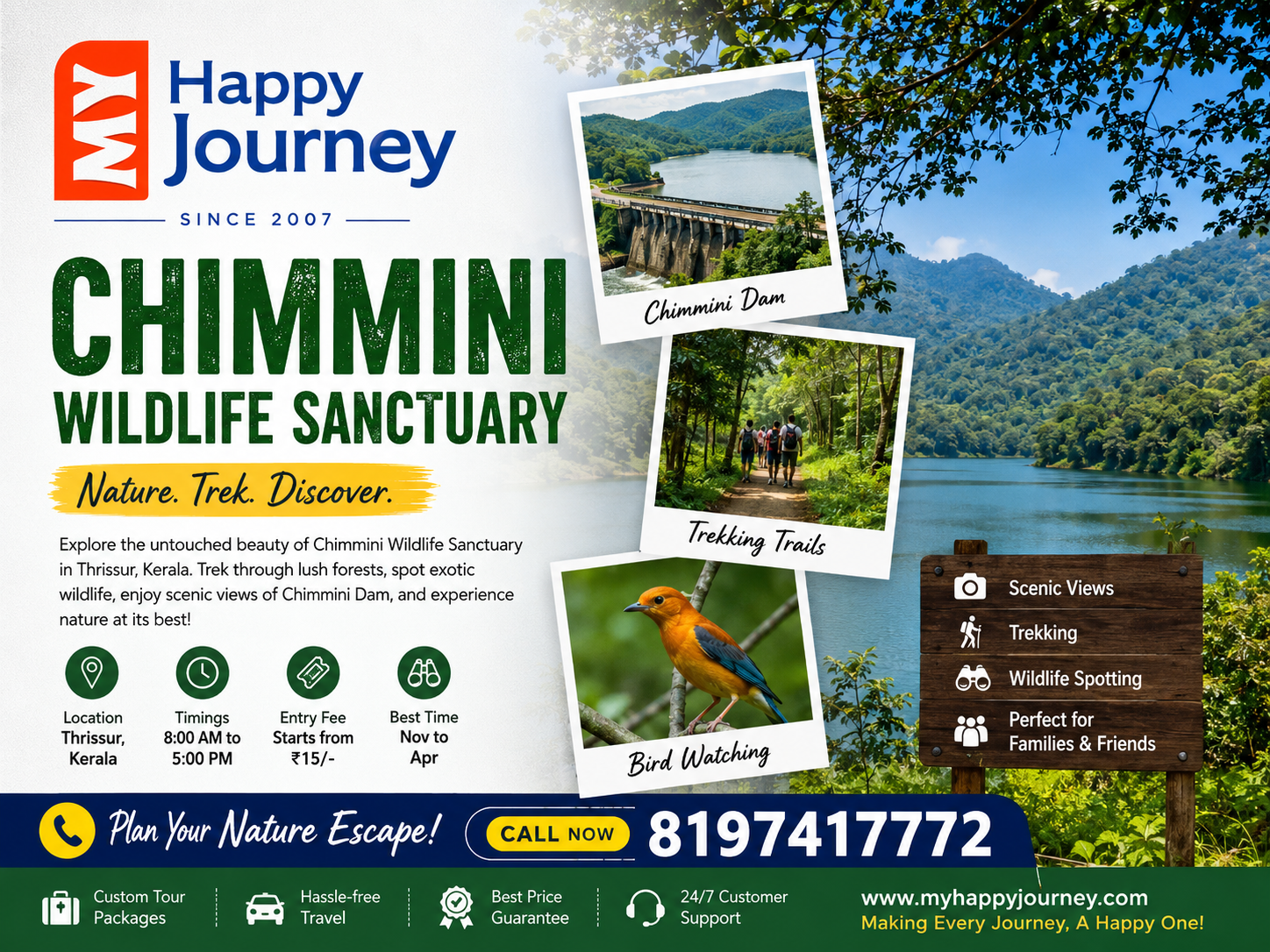
Wildlife, Trekking, Timings, Entry Fee & Best Time to Visit
Nestled in the Western Ghats of Kerala, Chimmini Wildlife Sanctuary is one of Thrissur’s quieter nature destinations. Surrounded by dense tropical forests, hills, streams and the scenic Chimmini Dam, the sanctuary is a good choice for travelers looking for trekking, birdwatching, photography and peaceful time in nature.
For travelers searching for Chimmini Wildlife Sanctuary Kerala, this guide covers everything you need to know—from the Chimmini Wildlife Sanctuary location and distance to timings, entry fees, trekking, sightseeing and the best time to visit.


6
Chimmini Wildlife Sanctuary at a Glance
| Information | Details |
|---|---|
| Location | Pariyaram, Thrissur district, Kerala |
| Region | Western Ghats |
| Established | 1984 |
| Area | About 85 sq km |
| Nearest major railway station | Thrissur |
| Nearest airport | Cochin International Airport |
| Main attractions | Wildlife, forests, Chimmini Dam, trekking, birdwatching |
| Best time to visit | November to April |
| Recommended duration | Half day to a full day |
| Main activities | Trekking, birdwatching, boating/eco-tourism activities, photography |
Kerala Tourism describes Chimmini as a sanctuary in the western slopes of the Nelliyampathy Hills and notes its rich biodiversity, trekking and bamboo-rafting opportunities. The Kerala Forest Department lists Chimmony Wildlife Sanctuary among Kerala’s wildlife sanctuaries, with an area of about 85 sq km and formation year 1984.
Where Is Chimmini Wildlife Sanctuary?
Chimmini Wildlife Sanctuary is located in Pariyaram in Thrissur district, Kerala, in the Western Ghats.
The sanctuary lies close to other important forest landscapes, including the Peechi-Vazhani Wildlife Sanctuary and the Parambikulam landscape. Its location makes it particularly attractive for travelers who want to experience Kerala’s forested Western Ghats without visiting the state’s more crowded tourist destinations.
The official Kerala Tourism listing gives the sanctuary’s coordinates as approximately 10.438858° N, 76.478519° E.
Chimmini Wildlife Sanctuary Location
Chimmini Dam Road, Pariyaram, Thrissur, Kerala 680304 is the commonly listed location for the sanctuary area.
Why Visit Chimmini Wildlife Sanctuary?
Unlike some of Kerala’s better-known wildlife destinations, Chimmini has a relatively peaceful atmosphere. The experience here is more about forest landscapes, guided trekking, birds, butterflies, streams and the reservoir than guaranteed large-animal sightings.
The sanctuary supports a diverse range of mammals, birds, reptiles, amphibians and fish. Kerala Tourism mentions species including elephants, sambar, gaur, Malabar squirrels and sloth bears, along with several endangered and endemic species.
It is especially appealing to:
- Nature lovers
- Birdwatchers
- Wildlife photographers
- Trekking enthusiasts
- Families looking for a nature outing
- Couples looking for a quiet destination
- Travelers exploring offbeat places in Thrissur
Chimmini Wildlife Sanctuary Sightseeing
1. Chimmini Dam
The Chimmini Dam is one of the major attractions associated with the sanctuary.
The reservoir creates a beautiful setting surrounded by forest-covered hills. Kerala Tourism notes that the dam was constructed across the Kurumali River, a tributary of the Karuvannur River.
The calm reservoir and surrounding greenery make the area particularly attractive for:
- Nature photography
- Landscape photography
- Relaxing by the water
- Birdwatching
- Family outings
- Eco-tourism activities
2. Forest Trekking
Trekking is one of the best ways to experience Chimmini.
Kerala Tourism’s official eco-tourism listing describes a trek from Virakuthodu to Choorathala, covering approximately 5 km and taking around 3 hours. The trek is guided and passes through forest landscapes with opportunities to observe birds and butterflies.
This is a better option for travelers who want more than simply visiting the dam.
3. Birdwatching
Chimmini’s forests provide habitat for a wide variety of birds. Kerala Tourism records around 192 bird species, including Western Ghats endemics.
Carry binoculars if birdwatching is one of your priorities, and allow yourself plenty of time rather than rushing through the forest.
4. Butterfly Watching
The forest ecosystem also supports a wide range of butterflies.
The sanctuary is particularly interesting for photographers who enjoy capturing butterflies, insects and smaller forest creatures.
5. Wildlife Watching
Chimmini is home to diverse wildlife, including elephants, gaur, sambar, Malabar squirrels and other forest species. Kerala Tourism also lists species such as Nilgiri langurs, slender lorises and wild dogs among the sanctuary’s biodiversity.
However, wildlife sightings are never guaranteed. Visitors should treat the forest experience itself as the main attraction rather than expecting a safari-style animal encounter.
Things to Do in Chimmini Wildlife Sanctuary
Trekking
Join a guided forest trek to explore the sanctuary’s interior landscapes. The Virakuthodu–Choorathala trek is one of the officially listed experiences.
Birdwatching
Spend time quietly observing birds in the forest rather than simply walking through the trail.
Wildlife Photography
Carry a camera with an appropriate zoom lens. Avoid getting too close to animals and follow forest department instructions.
Nature Photography
The reservoir, forest canopy, hills, streams and changing light offer excellent landscape photography opportunities.
Bamboo Rafting and Eco-Tourism
Kerala Tourism lists bamboo rafting and other forest-based eco-tourism experiences at Chimmini. Availability can depend on weather and operational conditions, so confirm before traveling.
Chimmini Wildlife Sanctuary Timings
The official Kerala Tourism eco-tourism page currently lists the sanctuary/trekking programme timing as:
8:00 AM to 5:00 PM
For the trekking programme, trekking tickets are issued only until 2:00 PM.
Because forest access and eco-tourism activities can change depending on weather, forest conditions and departmental instructions, it is advisable to confirm the latest operating details before travelling.
Chimmini Wildlife Sanctuary Opening Time
The currently listed eco-tourism opening time is 8:00 AM.
Chimmini Wildlife Sanctuary Entry Fee & Ticket Price
The official Kerala Tourism eco-tourism page currently lists:
| Visitor / Service | Fee |
|---|---|
| Indian adult | ₹15 |
| Student | ₹10 |
| Foreign national | ₹165 |
| Still camera | ₹55 |
| Video camera | ₹240 |
| Guided trek | ₹150 per person |
The listed trek requires a minimum of three people.
Important
Fees and eco-tourism packages can change. Therefore, treat these as currently published reference rates rather than guaranteed prices and confirm with the forest department before your visit.
The official eco-tourism listing also states that availability of packages can be affected by climate and other conditions.
Chimmini Wildlife Sanctuary Best Time to Visit
The best time to visit Chimmini Wildlife Sanctuary is generally November to April.
Kerala Tourism specifically recommends November through April.
November to February
This is a particularly pleasant period for:
- Trekking
- Birdwatching
- Photography
- Forest exploration
- Spending time around the reservoir
The weather is generally more comfortable than during the wetter months.
March to April
These months can also be suitable for visiting, although daytime temperatures may become warmer.
Monsoon Season
Chimmini receives substantial rainfall, and the forest becomes exceptionally green during the monsoon. However, heavy rain can affect trekking and other outdoor activities.
If trekking is your main objective, check weather and activity availability before travelling.
How Many Days Are Enough for Chimmini Wildlife Sanctuary?
For most travelers, half a day to one full day is sufficient.
Half-Day Visit
Suitable if you mainly want to:
- See Chimmini Dam
- Enjoy the scenery
- Take photographs
- Spend some time in nature
Full-Day Visit
A full day is better if you want to combine:
- Dam sightseeing
- Trekking
- Birdwatching
- Photography
- Eco-tourism activities
If you’re building a larger Thrissur travel itinerary, Chimmini can be included as a nature-focused day trip.
Suggested Chimmini Wildlife Sanctuary Itinerary
One-Day Chimmini Itinerary
Morning
Arrive at Chimmini and complete the required entry formalities.
Spend some time around the dam and reservoir before beginning your main activity.
Late Morning
Start the guided trek if you have booked the trekking experience.
The official Virakuthodu–Choorathala trek is approximately 5 km and takes around three hours.
Afternoon
Return from the trek and enjoy the surrounding natural scenery.
Have lunch according to the facilities available and your own arrangements.
Evening
Spend some quiet time around the dam area, take photographs and begin your return journey.
Tip: If trekking is your priority, don’t arrive too late. Trekking tickets on the official eco-tourism listing are issued only until 2 PM.
How to Reach Chimmini Wildlife Sanctuary
By Road
Road travel is the most convenient option for most tourists.
The official Kerala Tourism eco-tourism page states that Chimmini is about 26 km from Pudukkad Bus Station and approximately 2.5 hours by road from Kochi, depending on traffic and route.
By Train
The nearest major railway station is Thrissur Railway Station.
Official Kerala Tourism sources give the distance as approximately 30–38 km, depending on the reference point used within the sanctuary area.
From Thrissur, travelers can continue by taxi or other local transportation.
By Air
The nearest major airport is Cochin International Airport (COK).
Kerala Tourism lists the airport at approximately 58 km, while its eco-tourism page gives around 63 km to the sanctuary. The actual driving distance will depend on the route and destination point.
Chimmini Wildlife Sanctuary Distance
Approximate distances commonly published by Kerala Tourism are:
- Pudukkad Bus Station: about 26 km
- Thrissur Railway Station: about 30–38 km
- Cochin International Airport: about 58–63 km
- Kochi: around 2.5 hours by road
These should be treated as approximate because driving distance varies according to the starting point and route.
Where to Stay Near Chimmini Wildlife Sanctuary
For a wider choice of hotels and restaurants, travelers can consider staying in and around Thrissur and plan Chimmini as a day trip.
For a more immersive nature experience, check the forest department’s currently available eco-tourism or camping programmes. Some packages may require advance arrangements and are subject to availability.
Chimmini Wildlife Sanctuary for Different Travelers
For Couples
The quiet reservoir, forest scenery and relatively peaceful atmosphere make Chimmini a good option for couples who prefer nature-focused experiences.
For Families
Families can enjoy the dam, scenery and easier nature activities. For trekking, consider the age and fitness of children before choosing a trail.
For Adventure Travelers
Trekking and eco-tourism activities make Chimmini more appealing to travelers looking for an active experience.
For Birdwatchers
Chimmini is particularly attractive because of its extensive bird diversity and Western Ghats habitat.
For Photographers
The combination of forest, water, hills, birds and butterflies creates plenty of subjects for nature photography.
Chimmini Wildlife Sanctuary Photos
If you’re searching for Chimmini Wildlife Sanctuary photos, some of the best subjects to photograph include:
- Chimmini Dam
- Forest-covered hills
- Reservoir views
- Trekking trails
- Birds
- Butterflies
- Forest streams
- Wildlife, from a safe and permitted distance
- Early morning landscapes
Photography tip: Use a zoom lens for wildlife and birds rather than approaching animals. Follow all photography restrictions and instructions from forest officials.
Travel Tips for Chimmini Wildlife Sanctuary
- Start early, particularly if trekking is part of your plan.
- Wear comfortable walking shoes.
- Carry drinking water.
- Carry binoculars if you enjoy birdwatching.
- Use insect protection.
- Carry rain protection during the wetter months.
- Avoid loud music and unnecessary noise inside forest areas.
- Never feed or approach wild animals.
- Do not litter.
- Follow instructions from forest officials and guides.
- Confirm trekking and eco-tourism availability before travelling.
- If travelling with children or senior citizens, choose activities according to their fitness levels.
- Keep your camera ready, but prioritize responsible wildlife viewing.
Places to Combine with Chimmini Wildlife Sanctuary
If you’re creating a broader Thrissur or Kerala itinerary, Chimmini can be combined with other attractions depending on your route and available time.
Possible additions include:
- Thrissur city attractions
- Peechi-Vazhani area
- Athirappilly Waterfalls
- Vazhachal
- Other Western Ghats destinations
The best combination depends on where you’re staying and whether your priority is wildlife, waterfalls, sightseeing or relaxation.
Is Chimmini Wildlife Sanctuary Worth Visiting?
Yes—especially if you enjoy forests, trekking, birds, photography and less-crowded nature destinations.
Chimmini isn’t necessarily the place to visit if your only goal is to guarantee sightings of large animals. Instead, its appeal comes from the overall Western Ghats experience: dense forest, biodiversity, trekking trails, butterflies, birds, hills and the peaceful Chimmini reservoir.
For travelers exploring Chimmini Wildlife Sanctuary Thrissur, it can be an excellent addition to a Kerala itinerary focused on nature and offbeat experiences.
Frequently Asked Questions
What is Chimmini Wildlife Sanctuary famous for?
Chimmini Wildlife Sanctuary is a good choice for travellers who want to experience a quieter side of Kerala’s forests. Located in Thrissur district, the sanctuary combines tropical forest, wildlife, trekking opportunities and the scenic Chimmini reservoir. It was established in 1984 and forms part of Kerala’s Western Ghats protected-area network.
Below is a detailed FAQ written in a natural, blog-friendly style.
1. Where is Chimmini Wildlife Sanctuary located?
Chimmini Wildlife Sanctuary is located in Thrissur district, Kerala, in the Chalakudy forest division. It lies on the western slopes of the Nelliyampathy Hills and is close to the Peechi-Vazhani Wildlife Sanctuary.
Its relatively peaceful forest setting makes it an interesting alternative to some of Kerala’s more heavily visited wildlife destinations.
2. When was Chimmini Wildlife Sanctuary established?
Chimmini Wildlife Sanctuary was established in 1984. The original government notification declared the area a sanctuary for protecting and developing its wildlife and natural environment.
The Kerala Forest Department currently lists Chimmony Wildlife Sanctuary among Kerala’s protected wildlife sanctuaries, with an area of about 85 sq km.
3. What is Chimmini Wildlife Sanctuary famous for?
Chimmini is known for its dense tropical forests, wildlife, trekking routes, reservoir and nature-based activities.
The sanctuary is particularly appealing to travellers who prefer forests and outdoor experiences rather than conventional sightseeing. Kerala Tourism highlights trekking, bamboo rafting and activities around Chimmini Dam as some of the attractions in the area.
4. What animals can be seen at Chimmini Wildlife Sanctuary?
Chimmini supports a variety of wildlife. Kerala Tourism mentions animals including:
- Elephants
- Sambar
- Gaur or Indian bison
- Sloth bears
- Indian giant squirrels
- Nilgiri langurs
- Slender lorises
- Malabar squirrels
The sanctuary is also associated with larger and more elusive species such as tigers and wild dogs.
Wildlife sightings are never guaranteed, so visitors should approach the sanctuary as a natural habitat rather than a conventional zoo or safari park.
5. Is Chimmini Wildlife Sanctuary good for birdwatching?
Yes. Chimmini’s forest habitat supports a variety of birdlife, making it an interesting destination for people who enjoy combining wildlife watching and birdwatching.
However, if birdwatching is the main purpose of your Kerala trip, destinations such as Thattekad may be more appropriate for a dedicated birding itinerary.
6. What is the best time to visit Chimmini Wildlife Sanctuary?
Kerala Tourism recommends November to April as a suitable period to visit Chimmini.
These months are generally more convenient for outdoor activities such as trekking and nature walks. During periods of heavy rain, forest conditions and trekking programmes can be affected.
7. What are the timings of Chimmini Wildlife Sanctuary?
Kerala Tourism’s ecotourism information currently lists the trekking programme from 8:00 AM to 5:00 PM, with trekking tickets issued until 2:00 PM.
Timings can vary depending on the particular activity, weather and forest conditions, so it is advisable to confirm before travelling.
8. Is there an entry fee for Chimmini Wildlife Sanctuary?
The published ecotourism information lists an entry fee of ₹15 for Indian adults, ₹10 for students and ₹165 for foreign nationals for the specified trekking programme. It also lists separate charges for cameras.
These charges are subject to change, and different activities may have different fees. It is best to confirm the current tariff before your visit.
9. Can I go trekking at Chimmini Wildlife Sanctuary?
Yes. Trekking is one of the main activities available at Chimmini.
One of the listed experiences is a trek from Virakuthodu to Choorathala, with the official ecotourism programme describing it as a forest trekking experience.
The availability and route conditions can change depending on weather and forest-management requirements.
10. Is Chimmini suitable for beginners who have never trekked?
It can be, depending on the route and the visitor’s fitness level.
If you are new to trekking, choose a guided programme rather than attempting to explore the forest independently. Forest trails can be very different from ordinary tourist walking paths.
11. Can I go bamboo rafting at Chimmini?
Yes. Bamboo rafting is one of the nature-based activities associated with Chimmini Wildlife Sanctuary. Kerala Tourism specifically lists bamboo rafting among the activities available in the area.
Availability can depend on weather, water conditions and the operation of the ecotourism programme.
12. What is Chimmini Dam?
Chimmini Dam is a scenic reservoir located in the forested surroundings of the sanctuary. The dam and reservoir add another dimension to a visit, particularly for travellers interested in nature and landscapes.
The area around the dam is also associated with boating and other visitor activities.
13. Can I go boating at Chimmini?
Yes. Boating is one of the activities mentioned by Kerala Tourism for visitors to the Chimmini area.
For visitors planning a trip specifically around boating, it is worth checking availability in advance because activities can be affected by weather and reservoir conditions.
14. Is Chimmini Wildlife Sanctuary good for families?
Yes, particularly for families who enjoy nature, forests and outdoor activities.
However, families travelling with very young children or elderly members should choose activities according to their fitness levels. A short visit around the dam and a suitable nature activity may be more comfortable than a demanding trek.
15. Is Chimmini Wildlife Sanctuary suitable for children?
Children who enjoy wildlife and nature can have a great experience at Chimmini. The forest environment can also make the trip educational, especially if children are interested in animals, birds, trees and conservation.
Parents should keep children close during forest activities and follow the instructions of guides and forest staff.
16. Can I see elephants at Chimmini Wildlife Sanctuary?
Yes. Elephants are among the wildlife species associated with Chimmini. Kerala Tourism specifically lists elephants among the animals that visitors may encounter.
However, elephant sightings are not guaranteed. They are wild animals, and visitors should maintain a safe distance and follow forest-department instructions.
17. Are tigers found in Chimmini Wildlife Sanctuary?
Kerala Tourism lists tigers among the endangered species present in the sanctuary.
That does not mean visitors should expect to see a tiger during a normal visit. Tigers are elusive wild animals, and sightings are rare and unpredictable.
18. What should I carry for a Chimmini Wildlife Sanctuary trip?
For a comfortable visit, consider carrying:
- Comfortable walking shoes
- Lightweight clothing
- Drinking water
- Sunglasses
- Hat or cap
- Insect repellent
- Camera
- Binoculars
- Small backpack
- Rain protection during uncertain weather
- Basic personal medicines
For trekking, avoid carrying unnecessary heavy luggage.
19. Can I take photographs at Chimmini Wildlife Sanctuary?
Yes, nature and wildlife photography can be an enjoyable part of the experience.
A camera with a telephoto lens can be useful for photographing birds and wildlife from a safe distance. Visitors should never approach animals simply to get a better photograph.
20. Is Chimmini Wildlife Sanctuary safe for tourists?
A visit can be safe when travellers follow the rules of the forest department and stay with authorised guides or on designated routes.
Remember that Chimmini is a wildlife sanctuary, not a public park. Animals live freely in their natural habitat. Do not wander away from designated routes, feed animals or attempt to approach wildlife.
21. How do I reach Chimmini Wildlife Sanctuary?
Chimmini can be reached by road. Kerala Tourism’s ecotourism information places the sanctuary about 26 km from Pudukkad Bus Station, around 38 km from Thrissur Railway Station, and approximately 63 km from Cochin International Airport.
The exact journey time depends on your starting point, traffic and road conditions.
22. How far is Chimmini Wildlife Sanctuary from Thrissur?
The nearest major railway connection listed by Kerala Tourism is Thrissur Railway Station, approximately 38 km from the sanctuary according to the ecotourism programme information.
This makes Chimmini a possible addition to a Thrissur-based Kerala itinerary.
23. How far is Chimmini Wildlife Sanctuary from Kochi?
Kerala Tourism’s ecotourism information describes the journey from Kochi as approximately 2.5 hours by road, although actual travel time can vary depending on traffic and the exact starting location.
This makes Chimmini possible as a nature-focused excursion from Kochi for travellers with enough time.
24. Can I visit Chimmini Wildlife Sanctuary from Kochi in one day?
Yes, a one-day trip from Kochi is possible, particularly if you leave early.
However, if your plan includes trekking or multiple activities, starting early and confirming the programme beforehand is important. A rushed itinerary may not give you enough time to enjoy the forest.
25. Can I visit Chimmini from Thrissur?
Yes. Chimmini can be incorporated into a Thrissur wildlife and nature itinerary.
Travellers can combine the sanctuary with other attractions in the Thrissur region, depending on the length of their trip.
26. Is there accommodation inside Chimmini Wildlife Sanctuary?
Ecotourism programmes have included forest camping options. Kerala Tourism currently lists the Anaporu Overnight Stay, an interior forest camping programme that includes boating, trekking and food. The listed package price is ₹7,500 for three persons, but availability is subject to change.
If you specifically want to stay inside the forest, confirm availability before making travel arrangements.
27. What is the Anaporu Overnight Stay at Chimmini?
Anaporu is an interior forest camping experience listed under Chimmini’s ecotourism programmes. According to Kerala Tourism, the programme includes boating in the reservoir, trekking into the interior forest and food.
It can be an interesting option for travellers who want something more immersive than a short sightseeing visit.
28. Can I camp at Chimmini Wildlife Sanctuary?
Camping opportunities are available through specific ecotourism programmes rather than as unrestricted camping. The Anaporu programme is one example of an organised overnight forest experience.
Do not set up an independent campsite inside the sanctuary without official permission.
29. What makes Chimmini different from other wildlife sanctuaries in Kerala?
Chimmini combines forest wildlife, trekking, a reservoir and adventure-oriented ecotourism activities in one destination.
It can therefore appeal to travellers who want more than simply driving through a wildlife area. Trekking and bamboo rafting are among the experiences highlighted by Kerala Tourism.
30. Is Chimmini Wildlife Sanctuary worth visiting?
Yes, especially if you enjoy quiet forests, wildlife, trekking and nature-based travel.
It may not be the first choice for someone looking specifically for a large safari experience, but it can be a rewarding destination for travellers who want to explore a less conventional side of Kerala.
31. Can Chimmini Wildlife Sanctuary be included in a Kerala tour package?
Yes. Chimmini can be added to a Kerala itinerary depending on the route.
For example, travellers arriving in Kochi could consider:
Kochi → Chimmini → Thrissur → Munnar
Alternatively, it can be incorporated into a broader wildlife-focused route covering Chimmini, Peechi-Vazhani and other Western Ghats destinations.
32. What is a good one-day itinerary for Chimmini Wildlife Sanctuary?
A simple itinerary could look like this:
Early morning: Depart from your hotel
Morning: Reach Chimmini and complete entry formalities
Morning: Guided nature walk or trekking programme
Afternoon: Explore the reservoir/dam area and enjoy an available activity
Late afternoon: Begin return journey
The exact schedule should be adjusted according to the official activity timings and current availability.
33. What is the best season for trekking at Chimmini?
The period from November to April is recommended by Kerala Tourism for visiting Chimmini.
For trekking specifically, always check the latest trail and weather conditions because heavy rainfall can affect forest routes.
34. Can I visit Chimmini during the monsoon?
The monsoon can make the forest especially green and scenic, but heavy rainfall can also affect trekking, rafting and other outdoor activities.
Because ecotourism programmes are subject to climate and other conditions, Kerala Tourism advises visitors to confirm availability beforehand.
35. Is Chimmini Wildlife Sanctuary good for nature lovers?
Definitely. The sanctuary is a good option for travellers who prefer green landscapes, forest sounds, wildlife and outdoor activities over crowded tourist attractions.
The combination of tropical forest and the Chimmini reservoir gives the destination a distinctive character.
36. Is Chimmini better than Athirappilly for nature tourism?
They offer different experiences.
Athirappilly is famous primarily for its waterfalls and dramatic landscape, while Chimmini is more focused on forest, wildlife and ecotourism activities.
If you have enough time, both can be included in a Thrissur-region itinerary.
37. Is Chimmini Wildlife Sanctuary suitable for bird photography?
Yes. The forest habitat provides opportunities for bird photography, although sightings are unpredictable.
For serious bird photographers, it is worth combining Chimmini with dedicated birding destinations such as Thattekad Bird Sanctuary rather than relying on one location alone.
38. What are the nearby attractions to Chimmini Wildlife Sanctuary?
Depending on your route, you can combine Chimmini with other attractions in Thrissur and central Kerala. Peechi-Vazhani Wildlife Sanctuary is particularly relevant because Chimmini is located near it.
Travellers can also plan a longer route incorporating waterfalls, wildlife destinations and cultural attractions in the Thrissur region.
39. Do I need a guide for Chimmini trekking?
For organised sanctuary trekking, visitors should follow the official ecotourism programme and guide arrangements. A forest guide is particularly useful because you are travelling through a protected wildlife habitat.
The official ecotourism programme also specifies minimum group requirements for the listed trek.
40. What are the main things to do at Chimmini Wildlife Sanctuary?
The main experiences to consider are:
- Wildlife watching
- Birdwatching
- Forest trekking
- Nature walks
- Bamboo rafting
- Boating
- Exploring Chimmini Dam and reservoir
- Organised forest camping
- Wildlife photography
Availability depends on the particular programme and prevailing conditions.
41. What should I know before visiting Chimmini Wildlife Sanctuary?
The most important thing is to treat Chimmini as a protected forest ecosystem. Activities and access can change depending on weather, wildlife-management requirements and forest conditions.
Check the current ecotourism programme before travelling, especially if you are planning trekking, rafting, boating or an overnight stay. Kerala Tourism explicitly notes that ecotourism package availability can change because of climate and other conditions.
Chimmini Wildlife Sanctuary FAQ – Quick Travel Summary
| Information | Details |
|---|---|
| Location | Thrissur district, Kerala |
| Established | 1984 |
| Area | About 85 sq km according to Kerala Forest Department |
| Best time | November to April |
| Main attractions | Wildlife, forest, Chimmini Dam, trekking |
| Activities | Trekking, boating, bamboo rafting, camping |
| Nearest railway station | Thrissur |
| Nearest airport | Cochin International Airport |
| Ideal for | Nature lovers, trekkers, wildlife enthusiasts, families |
| Best experience | Guided forest and ecotourism activities |
The Kerala Forest Department currently lists Chimmony Wildlife Sanctuary at 85 sq km and formed in 1984, while Kerala Tourism’s destination page gives slightly different area figures, so for an SEO blog it is better to use the Forest Department’s current figure when quoting the sanctuary’s official area
Plan Your Chimmini Wildlife Sanctuary Trip
Chimmini Wildlife Sanctuary is a wonderful choice for travelers who want to experience a quieter side of Kerala. With its Western Ghats forests, Chimmini Dam, trekking trails, birdlife and rich biodiversity, it offers something different from the state’s more commercial tourist destinations.
Planning a trip to Chimmini? MyHappyJourney.com can help you plan a customized Kerala holiday based on your preferred dates, budget, hotels, sightseeing and transportation requirements. Contact the travel team to check the latest package options and rates.
Suggested Links
- Kerala Travel Guide
- Munnar Tour Packages
- Kerala Honeymoon Packages
- Kerala Family Tour Packages
- Thekkady Travel Guide
- Alleppey Travel Guide
- Kumarakom Travel Guide
- Best Places to Visit in Kerala
- Kerala 5 Nights 6 Days Tour Package
- Kerala 6 Nights 7 Days Tour Package
- 8 Days Kerala Tour packages
- Things to do in varkala
- Varkala travel guide
- Best cafes and restaurants in varkala
One Reply to “Chimmini Wildlife Sanctuary Travel Guide”