
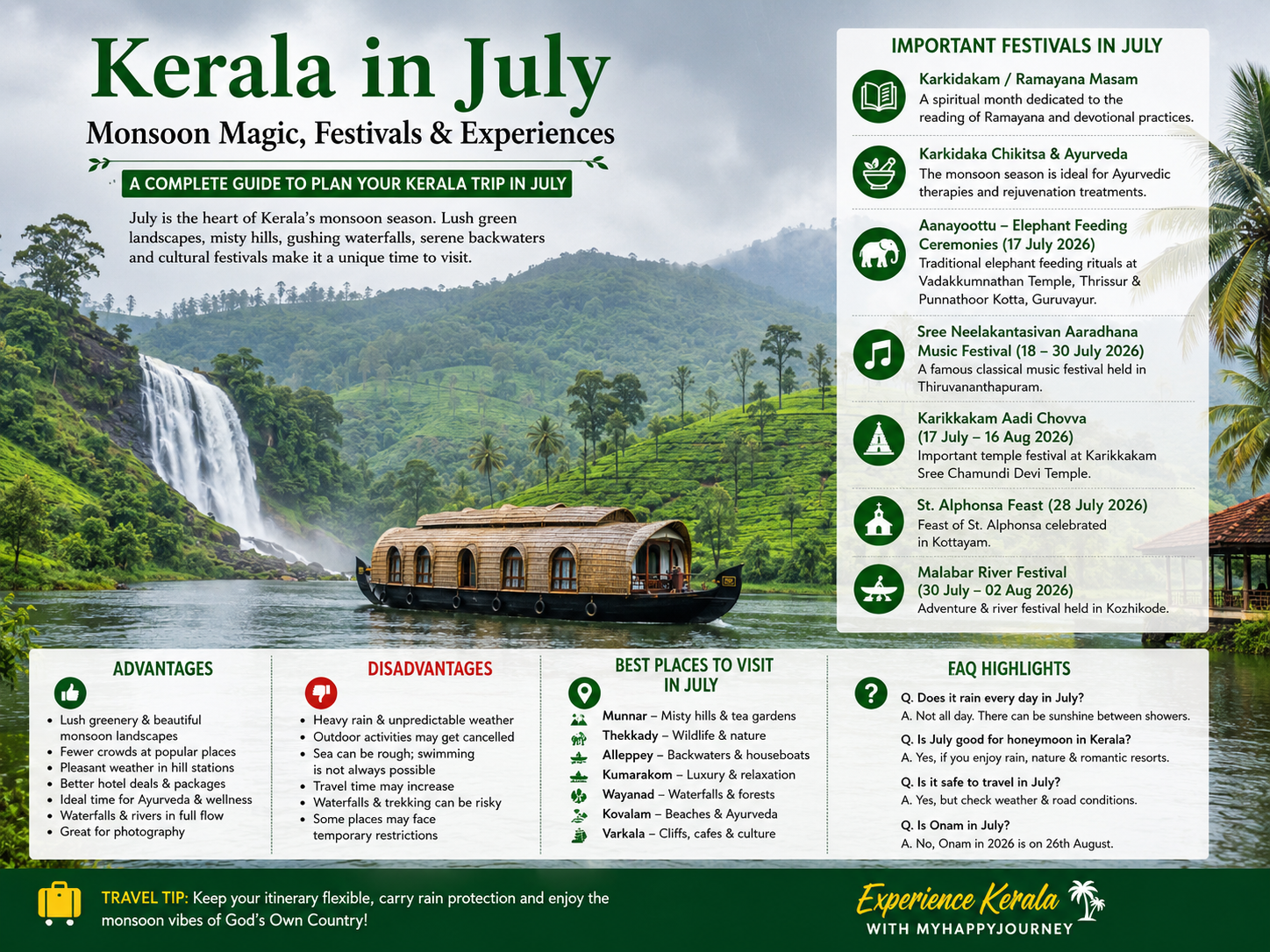
Kerala in July: A Complete Guide to Monsoon Travel, Festivals, Weather and Things to Do
Planning a Kerala trip in July? July is not the conventional peak-season choice for Kerala, but for travellers who enjoy rain, misty hills, lush landscapes, quieter destinations and authentic local experiences, it can be one of the most interesting months to visit.
July falls within Kerala’s southwest monsoon season. The rain changes the appearance of almost every part of the state. Tea gardens around Munnar become intensely green, waterfalls become more dramatic, rivers and backwaters fill up, and the Western Ghats often disappear behind layers of mist.
But July is not simply about sightseeing in the rain. The Malayalam calendar month of Karkidakam, which generally overlaps July and August, has an important place in Kerala’s cultural life. Traditional Ayurveda practices, temple rituals, devotional observances, Ramayana reading and seasonal food traditions become particularly prominent during this period.
For a traveller, this creates a different kind of Kerala holiday — slower, greener and more focused on nature, culture and relaxation.
Is July a Good Time to Visit Kerala?
Yes, July can be a very good time to visit Kerala, provided you are comfortable with monsoon weather.
Kerala’s southwest monsoon normally extends from June to September. July therefore falls right in the middle of the rainy season. Kerala Tourism describes the monsoon as a period when the state becomes exceptionally green, while also noting that rainfall is not necessarily continuous throughout the day. Rain may be followed by periods of sunshine.
The biggest difference between a July holiday and a winter holiday is the style of travel.
During November to February, travellers generally look for comfortable weather, sightseeing and outdoor activities.
In July, the experience is different:
- Green landscapes
- Mist-covered mountains
- Waterfalls and flowing streams
- Rainy-day views from resorts
- Ayurveda and wellness experiences
- Fewer tourists in many places
- Potentially better hotel and package prices
- A more relaxed holiday atmosphere
- Seasonal festivals and cultural experiences
If your idea of a holiday means spending every day outdoors under clear skies, July may not be ideal.
If you enjoy watching rain from a balcony, drinking hot tea while looking at mist-covered mountains and exploring Kerala at a slower pace, July can be surprisingly rewarding.
Kerala Weather in July
July is one of the wetter months in Kerala.
The southwest monsoon brings substantial rainfall to the state, although the intensity varies considerably between regions. Coastal areas, the midlands and the Western Ghats can experience different weather conditions on the same day.
Munnar in July
Munnar is one of the most attractive destinations during the monsoon.
The tea plantations become bright green, clouds move across the hills and mist frequently covers the roads and valleys.
Rain can sometimes affect sightseeing, so travellers should keep their itinerary flexible.
Munnar in July is particularly suitable for:
- Couples
- Nature lovers
- Photographers
- Families looking for a quiet holiday
- Travellers who enjoy cool weather
- People interested in monsoon landscapes
Thekkady in July
Thekkady and Periyar are also beautiful during the rainy season.
The forests become lush and the surroundings feel fresh after rainfall. However, some outdoor activities may be affected by weather conditions.
A July trip to Thekkady works best when you combine nature with indoor or flexible activities rather than planning every hour around outdoor sightseeing.
Alleppey and Kumarakom in July
The backwaters take on a very different character during the monsoon.
The landscape around Alappuzha and Kumarakom becomes greener, and rain falling over the backwaters can create a peaceful atmosphere.
A houseboat stay can be enjoyable in July, particularly for travellers who don’t mind occasional rain.
However, travellers should understand that a monsoon houseboat experience is different from a bright, sunny backwater cruise.
Kovalam in July
Kovalam remains attractive during July, but the sea can be rough and beach activities may be restricted depending on weather and local safety conditions.
This is a better month for enjoying a coastal resort, Ayurveda, relaxation and local sightseeing than planning a holiday entirely around swimming and water sports.
Why Kerala Looks So Beautiful in July
The rain changes Kerala’s landscape dramatically.
The vegetation becomes greener, waterfalls become more active and the hills often develop a soft layer of mist.
This is particularly noticeable in:
- Munnar
- Vagamon
- Thekkady
- Wayanad
- Kumarakom
- Alleppey
- Athirappilly
- Ponmudi
- Varkala
- The Western Ghats
Kerala Tourism itself describes the monsoon as a period of intense natural rejuvenation, with green landscapes and occasional sunny intervals rather than uninterrupted rain.
For photographers, July offers something that the dry season cannot easily reproduce — reflections, dramatic clouds, wet roads through plantations, mist and saturated greenery.
Important Festivals and Cultural Events in Kerala During July
July is particularly interesting from a cultural perspective because of the Malayalam month of Karkidakam.
Karkidakam is traditionally associated with spiritual practices, Ayurveda, seasonal food, temple observances and the reading of the Ramayana.
The exact dates of festivals vary from year to year because many Kerala festivals follow the Malayalam calendar.
1. Karkidakam / Ramayana Masam
Karkidakam is often referred to as Ramayana Masam, or the month associated with the Ramayana.
During this period, many Kerala Hindu households and temples observe traditions connected with reading and listening to the Ramayana.
The month has a reflective character. Rather than being a large public celebration like Onam, it is more closely connected with spirituality, family traditions and devotional practices.
For travellers interested in Kerala’s culture, this period provides an opportunity to see a side of the state that goes beyond beaches and sightseeing.
2. Karkidaka Chikitsa and Ayurveda
One of the most well-known associations with the Kerala monsoon is Ayurveda.
Traditional Ayurvedic practices and rejuvenation therapies are particularly associated with the monsoon season. Kerala Tourism notes that the atmosphere during the rainy season is traditionally considered suitable for Ayurvedic therapies, and Karkidaka Chikitsa is associated with this period.
Travellers can find wellness programmes involving:
- Ayurvedic massages
- Oil therapies
- Rejuvenation programmes
- Panchakarma programmes
- Herbal preparations
- Traditional dietary practices
However, travellers should choose established Ayurvedic centres and consult qualified practitioners rather than treating tourist massages as medical treatment.
3. Aanayoottu – Elephant Feeding Ceremonies
The monsoon period also features traditional elephant-related observances.
In 2026, Kerala Tourism’s monsoon festival calendar lists Aanayoottu at Vadakkumnathan Temple in Thrissur and Njangattiri Aanayoottu on July 17. It also lists an Ayurvedic rejuvenation programme for elephants at Punnathoor Kotta in Guruvayoor from July 17 to August 16.
These events are connected with Kerala’s temple traditions and the seasonal care of elephants.
Visitors should always follow temple rules and maintain a respectful distance from animals.
4. Sree Neelakantasivan Aaradhana Music Festival
Music lovers visiting Thiruvananthapuram in July 2026 can look out for the Sree Neelakantasivan Aaradhana Music Festival.
According to Kerala Tourism, the 2026 festival is scheduled from July 18 to July 30 at SSJDB Mandapam in Thiruvananthapuram.
The festival celebrates the musical legacy of Sree Neelakanta Sivan and brings together musicians from Kerala and neighbouring states.
This type of event is particularly interesting for travellers who want to experience classical Indian music rather than only visiting conventional tourist attractions.
5. Karikkakam Aadi Chovva
The Kerala Tourism monsoon festival calendar lists Karikkakam Aadi Chovva at Karikkakam Sree Chamundi Devi Temple in Thiruvananthapuram from July 17 to August 16, 2026.
It is associated with the Malayalam month of Karkidakam and is an important temple observance.
Visitors attending religious events should dress modestly and follow the customs and entry rules of the temple.
6. St. Alphonsa Feast
Kerala’s cultural identity is not limited to Hindu festivals.
The state has a long tradition of Christian feasts and celebrations as well.
Kerala Tourism’s 2026 monsoon calendar lists the Feast of St. Alphonsa and Saint Alphonsa Day in Kottayam on July 28, 2026.
For visitors exploring central Kerala, such celebrations can provide a glimpse into the state’s religious diversity.
7. Malabar River Festival
The Malabar River Festival is another event associated with Kerala’s monsoon season.
The 2026 Kerala Tourism festival calendar lists the event in Kozhikode from July 30 to August 2, 2026.
The event is particularly interesting for adventure travellers because the region’s rivers and monsoon landscape provide a dramatic setting for river-based activities.
Is Onam Celebrated in July?
Usually, no.
This is an important point for travellers planning a Kerala holiday.
Onam generally falls in August or September depending on the year. In 2026, Kerala Tourism lists Thiruvonam on August 26, 2026.
Therefore, if your main purpose is to experience the grand Onam celebrations, July is generally too early.
July is more closely associated with Karkidakam and monsoon-related traditions.
Advantages of Visiting Kerala in July
1. Lush Greenery
This is perhaps the biggest reason to visit.
The rain gives Kerala a fresh appearance. Hill stations, plantations, forests and countryside become exceptionally green.
2. Fewer Tourists
July is outside Kerala’s traditional peak tourist period.
You may find many popular places considerably more relaxed compared with the busy winter season.
Fewer visitors can mean a more peaceful experience at resorts, viewpoints and some attractions.
3. Potentially Lower Prices
Because July falls within the monsoon/off-season period, hotels and tour operators may offer attractive rates.
Kerala Tourism also identifies June to September as a period that can suit budget-conscious travellers, although weather conditions need to be considered.
Prices are not guaranteed to be lower everywhere, especially during specific events or weekends, so it is always worth comparing actual rates.
4. Excellent for Ayurveda
Travellers interested in traditional Ayurvedic wellness often specifically choose the monsoon period.
The combination of cooler weather, rain and seasonal Ayurvedic traditions makes July a popular period for wellness holidays.
5. Beautiful Munnar
Munnar is particularly attractive to travellers who enjoy mist, rain and greenery.
Instead of seeing dry tea estates under bright sunlight, you may experience layers of clouds moving through the mountains.
6. Romantic Atmosphere
For couples, monsoon Kerala can be very appealing.
A resort overlooking tea plantations, a private balcony, rain outside and a warm cup of tea can be more memorable than a tightly scheduled sightseeing day.
7. Cultural Experiences
July provides opportunities to experience traditions associated with Karkidakam, Ayurveda, temple festivals, music and religious observances.
Disadvantages of Visiting Kerala in July
July is not perfect for everyone.
1. Heavy Rain
Rainfall can be intense at times.
A sightseeing plan that looks perfect on paper may need to change because of weather.
2. Outdoor Activities Can Be Cancelled
Certain activities may be affected by rain or water conditions.
Depending on local conditions, trekking, boating, adventure activities and other outdoor experiences can be restricted.
3. Sea Conditions Can Be Rough
At coastal destinations, monsoon conditions can make the sea unsuitable for swimming.
Do not assume that a beach holiday means you can enter the water whenever you want. Follow local safety instructions.
4. Travel Can Take Longer
Wet roads, reduced visibility and traffic can increase journey times.
This is particularly important when planning long road journeys between destinations.
It is better to keep some buffer time rather than planning a packed itinerary.
5. Waterfalls Require Caution
Waterfalls are spectacular during the monsoon, but heavy rainfall can also make them dangerous.
Do not enter restricted areas, climb slippery rocks or ignore barricades simply to get a better photograph.
6. Weather Is Unpredictable
Kerala Tourism notes that recent rainfall patterns can be unpredictable, including episodes of intense rain and extreme weather.
Therefore, July travellers should be flexible.
What Should You Pack for Kerala in July?
A monsoon trip requires a slightly different packing strategy.
Essential items
- Lightweight raincoat
- Compact umbrella
- Waterproof footwear
- Extra pairs of socks
- Quick-drying clothes
- Small waterproof bag
- Phone waterproof pouch
- Power bank
- Mosquito repellent
- Sunscreen
- Personal medicines
- Light sweater or jacket for hill stations
- Plastic or waterproof bags for wet clothing
Kerala Tourism also recommends carrying rain protection, suitable footwear, medicines and warm clothing for high-range destinations.
Avoid carrying too many heavy clothes. Kerala is humid, and quick-drying clothing is much more practical during the monsoon.
Best Kerala Destinations to Visit in July
Munnar
Best for: Mountains, tea plantations, mist and couples
Munnar is one of the strongest choices for a July Kerala holiday.
Thekkady
Best for: Forests, nature and wildlife
Thekkady works well for travellers who prefer greenery and a quieter environment.
Alleppey
Best for: Backwaters and houseboats
The monsoon gives the backwaters a dramatic appearance.
Kumarakom
Best for: Luxury resorts, backwaters and relaxation
Kumarakom is particularly suitable for travellers who want to spend more time at the resort rather than constantly moving between attractions.
Wayanad
Best for: Nature, waterfalls, forests and scenic drives
Wayanad can be extremely green during the monsoon, but travellers should check local weather and road conditions before heading into remote areas.
Kovalam
Best for: Resorts, Ayurveda and relaxation
Choose Kovalam in July for the resort and wellness experience rather than expecting perfect beach weather.
Varkala
Best for: Cliffs, cafes, coastal views and relaxation
Varkala can be peaceful during the monsoon, but sea conditions need to be respected.
Athirappilly
Best for: Waterfalls and photography
The monsoon can make the waterfalls spectacular, but safety should come before photography.
Suggested 6 Nights / 7 Days Kerala Itinerary for July
A balanced July itinerary could look like this:
Day 1 – Kochi
Arrive in Kochi.
Visit Fort Kochi, Chinese fishing nets and Mattancherry if weather permits.
Overnight in Kochi.
Day 2 – Kochi to Munnar
Drive towards Munnar.
Enjoy the changing landscape as the route climbs into the Western Ghats.
Overnight in Munnar.
Day 3 – Munnar
Explore tea plantations, viewpoints and local attractions.
Keep the schedule flexible because of rain.
Overnight in Munnar.
Day 4 – Munnar to Thekkady
Drive towards Thekkady.
Enjoy the forested landscape.
Overnight in Thekkady.
Day 5 – Thekkady to Alleppey
Proceed to Alappuzha.
Check into a houseboat or backwater resort depending on the package.
Enjoy the backwaters.
Overnight in Alleppey.
Day 6 – Alleppey to Kovalam
Travel towards Kovalam.
Relax at the resort and explore the surrounding area if weather permits.
Overnight in Kovalam.
Day 7 – Kovalam and Departure
Enjoy breakfast and some relaxed sightseeing depending on departure time.
Transfer to Thiruvananthapuram Airport/Railway Station.
Who Should Visit Kerala in July?
July is particularly suitable for:
- Couples
- Honeymoon travellers
- Nature lovers
- Photographers
- Ayurveda and wellness travellers
- Families who don’t mind occasional rain
- Travellers looking for quieter holidays
- Budget-conscious travellers
- People who enjoy monsoon landscapes
- Repeat visitors who want to experience a different Kerala
Who Should Avoid Kerala in July?
July may not be the best choice if you:
- Want guaranteed sunshine
- Want to spend most days swimming at beaches
- Have a very tight sightseeing schedule
- Want extensive trekking
- Are uncomfortable travelling in rain
- Prefer predictable weather
- Are travelling with very young children and want an entirely outdoor-focused itinerary
This does not mean Kerala should be avoided altogether. It simply means the itinerary should be designed around the weather.
How to Make a Kerala July Trip Better
The biggest mistake is trying to use a winter itinerary during the monsoon.
Instead:
Keep mornings flexible.
Rain can come and go, so don’t assume that rain at 8 AM means the entire day is lost.
Don’t overload the itinerary.
Choose fewer places and spend more time at each destination.
Choose good hotels.
During monsoon, your hotel becomes part of the holiday experience.
A beautiful resort with a mountain or backwater view can be much more valuable in July than an inexpensive hotel where you have little to do when it rains.
Keep backup activities.
If a sightseeing point is inaccessible, have alternatives such as:
- Ayurveda
- Cooking experiences
- Local food
- Museums
- Cultural performances
- Cafes
- Resort activities
- Shopping
Frequently Asked Questions About Kerala in July
1. Is July a good month for a Kerala trip?
Yes. July is suitable for travellers who enjoy monsoon weather, greenery, mist, Ayurveda and fewer crowds. It is less suitable for travellers looking for guaranteed sunshine and beach activities.
2. Does it rain every day in Kerala in July?
Not necessarily.
Kerala Tourism notes that the monsoon does not mean continuous rain throughout the day. There can be periods of sunshine between showers, although heavy rain can occur.
3. Is Munnar worth visiting in July?
Yes.
Munnar is one of the most attractive destinations during the monsoon if you enjoy mist, tea plantations and cool mountain weather.
However, visibility may sometimes be poor and certain outdoor activities can be affected by rain.
4. Is it safe to travel to Kerala in July?
Generally, Kerala is a well-established tourist destination and July travel is possible.
However, monsoon conditions can occasionally create heavy rainfall, flooding, landslides or road disruptions in specific locations.
Always check local weather and road conditions before travelling to areas affected by heavy rain.
5. Can I stay on a houseboat in Alleppey in July?
Yes, houseboat stays operate during the monsoon.
The experience is different from a sunny-season cruise, but many travellers enjoy the rain, greenery and atmosphere of the backwaters.
Always check weather and operational conditions with your operator before departure.
6. Can I swim in Kerala beaches in July?
It depends on the location and current sea conditions.
During the monsoon, waves and currents can become dangerous. Do not enter the sea unless local authorities or lifeguards indicate that swimming is safe.
7. Is July good for a honeymoon in Kerala?
It can be excellent for couples who enjoy rain and romantic resort experiences.
Munnar, Kumarakom, Alleppey and selected luxury resorts can work particularly well.
If your dream honeymoon is mostly sunny beaches and outdoor activities, another season may be more appropriate.
8. Is Kerala cheaper in July?
It can be.
July is generally considered an off-season period, and some hotels and tour operators offer attractive rates.
However, pricing depends on hotel category, destination, weekends, holidays and demand.
9. Is July good for Ayurveda in Kerala?
July falls within the traditional monsoon period associated with Ayurvedic wellness practices in Kerala.
Karkidaka Chikitsa is particularly associated with Karkidakam.
Anyone seeking treatment for a medical condition should consult a qualified practitioner rather than choosing a treatment solely because it is marketed to tourists.
10. What is Karkidakam in Kerala?
Karkidakam is a Malayalam calendar month that generally falls around July-August.
It is traditionally associated with the monsoon, spirituality, Ramayana reading, Ayurveda and seasonal practices.
11. What is Ramayana Masam?
Ramayana Masam refers to the period in Karkidakam when reading and listening to the Ramayana is traditionally observed in many Kerala households and temples.
It has a spiritual and reflective significance for many people.
12. Is Onam celebrated in July?
Usually not.
The date of Onam changes each year. In 2026, Thiruvonam falls on August 26.
Travellers specifically looking for major Onam celebrations should check the festival calendar for the year they plan to visit.
13. Are Kerala waterfalls open in July?
Some waterfalls and viewpoints may be open, while others may be restricted depending on rainfall and safety conditions.
July can produce impressive waterfalls, but heavy rain also increases the risks of slippery surfaces and sudden increases in water flow.
14. Is July good for Wayanad?
Yes, particularly for travellers who love greenery and monsoon scenery.
However, Wayanad receives substantial rainfall, so check road conditions and local restrictions before travelling.
15. Is July good for Thekkady?
Yes.
The forests become lush and the scenery is beautiful.
However, activities such as boating, trekking and other outdoor experiences can be affected by weather.
16. Should I visit Kovalam in July?
Yes, if your priority is relaxation, resorts, Ayurveda and coastal scenery.
If your main objective is swimming and water sports, July may not be ideal.
17. What clothes should I wear in Kerala in July?
Choose light, quick-drying clothes.
Carry a raincoat, umbrella, waterproof footwear and an extra change of clothes.
If you are travelling to Munnar or another high-range destination, carry a light jacket as temperatures can feel considerably cooler.
18. How many days are enough for Kerala in July?
A 5 to 7-night trip is a good starting point.
For a first visit, a route such as Kochi – Munnar – Thekkady – Alleppey – Kovalam provides a good mix of hills, forests, backwaters and coast.
19. Is Kerala suitable for a family holiday in July?
Yes, provided the family is comfortable with rain.
Families should avoid overly packed itineraries and allow additional travel time.
Resorts with indoor facilities are particularly useful during the monsoon.
20. Is Kerala good for couples in July?
Yes.
The combination of misty hills, rain, backwaters, resorts and Ayurveda can make July particularly appealing for couples.
21. Is July good for photography in Kerala?
Absolutely.
Monsoon clouds, mist, waterfalls, wet roads, tea plantations and intensely green landscapes provide excellent photographic opportunities.
Just protect your camera and phone from rain.
22. What is the biggest disadvantage of Kerala in July?
The biggest disadvantage is unpredictable weather.
Rain can alter sightseeing plans, outdoor activities may be restricted and road journeys can sometimes take longer.
23. What is the biggest advantage of Kerala in July?
The biggest advantage is the monsoon landscape combined with fewer crowds.
Kerala looks dramatically different during the rainy season, and travellers who appreciate nature often find this version of the state more memorable than the peak-season experience.
Final Verdict: Should You Visit Kerala in July?
Yes — if you choose the right type of holiday.
July Kerala is not about ticking off twenty sightseeing points in seven days.
It is about slowing down.
It is waking up to rain on the window, watching mist move across Munnar’s tea plantations, travelling through impossibly green landscapes, enjoying a houseboat while rain falls over the backwaters, experiencing Kerala’s monsoon traditions and perhaps spending an afternoon at an Ayurvedic wellness centre.
There will be rain. Some plans may change. A few attractions may be temporarily unavailable.
But that is also what makes a July trip different.
If you want sunny beaches and predictable outdoor sightseeing, consider November to February.
If you want green landscapes, monsoon beauty, Ayurveda, cultural experiences, fewer crowds and potentially better-value stays, July deserves serious consideration.
Kerala during the monsoon is not simply Kerala with rain.
It is a completely different mood.
Planning a Kerala Trip in July?
A well-designed monsoon itinerary should leave enough flexibility for weather changes instead of following a rigid schedule.
For a first-time visitor, a combination of Munnar + Thekkady + Alleppey/Kumarakom + Kovalam can provide a good introduction to Kerala’s mountains, forests, backwaters and coastline.
Before travelling, check the latest weather, local advisories, attraction operating conditions and festival dates because monsoon conditions and event schedules can change.
MyHappyJourney can help travellers plan customised Kerala holidays based on the number of days, budget, hotel preference, family size and destinations they want to cover.
Quick Kerala July Travel Checklist
- Check the weather before each day’s sightseeing
- Keep a flexible itinerary
- Carry rain protection
- Use waterproof bags for electronics
- Keep extra travel time
- Check waterfall and trekking restrictions
- Follow beach safety instructions
- Choose reputable hotels and transport operators
- Confirm festival dates before travelling specifically for an event
- Don’t pack too many sightseeing points into one day
- Keep at least one indoor/relaxation option available
- Enjoy the monsoon rather than trying to avoid it
Kerala in July is best experienced slowly — with a little patience, an open itinerary and an appreciation for the rain.